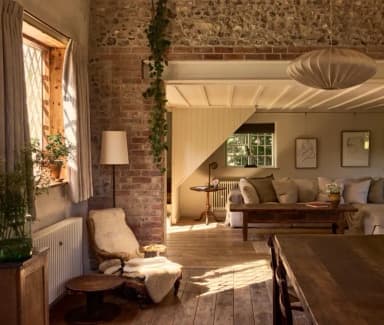
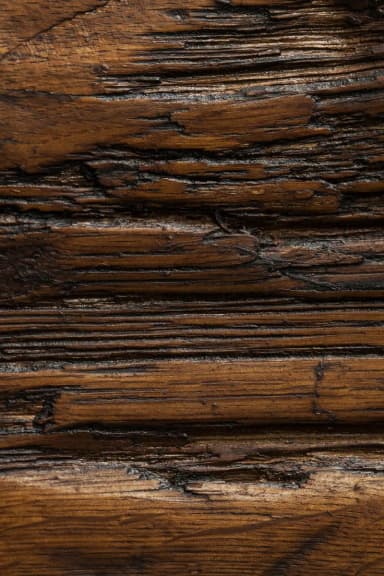



From standing tree to finished plank, the story of a wood floor is one of transformation, and also one of waste.
Remember the last time you looked at "premium" wood flooring? Perfectly uniform planks, with no knot in sight?
In the pursuit of flawless uniformity, the flooring trade has long passed over a source of beauty and sustainability: the "imperfections" that make each piece of wood different. Those flawless boards come at a cost in wood.
Zero waste design is a movement that makes us rethink how we make and furnish our homes.
The short answer
- Zero waste design plans products so that as little material as possible is left over, from the first cut to the end of the product's life.
- Making flooring loses a lot of wood. Turning rough lumber into finished boards can lose around half of it in the common grades, and around 30% in the clear grades.
- Clear grades leave out knots and colour changes. Using more of the tree means accepting its character.
- Reclaimed wood goes further, reusing boards that have already been cut.

Image credit: Laura Krause, Redress
From waste to wonder
Zero waste design is about more than recycling or producing less rubbish. It asks a bolder question: what if we designed in a way that left nothing behind?
In South Philadelphia, the clothing brand Lobo Mau made a capsule collection of furniture with the designer Jen Tiberi: vintage pieces reupholstered in its fabric remnants, and pillows filled with shredded offcuts, a collection it describes as 90% zero waste. It is a clear example of "waste" becoming something worth keeping.
The movement now reaches from fashion to furniture, and it challenges our attachment to uniformity. Nowhere is that shift more striking than in our homes, and in how we think about wood floors.

Image credit: Lobo Mau

Image credit: Lobo Mau
The hidden cost of perfection
Turning rough timber into flooring loses a great deal of wood. Answering on the trade forum Woodweb, Gene Wengert explains that mills using the common grades "get about 50% yield": 1,000 board feet of rough, dried lumber gives around 500 board feet of flooring. For clear grades, about 30% waste "seems like a good estimate".
Much of that loss is milling. But grading plays its part: the clear grades are clear precisely because the knots, the strong grain and the colour changes have been cut out, and those are often the most beautiful parts of the tree's story.
It is a little like throwing away good vegetables because they are not quite the right shape for the supermarket shelf.

A reclaimed wood floor under a freestanding bath at Cliftonville Mews
More than a buzzword
Zero waste looks at the whole life of a material, from design and manufacture to use and reuse. As Lobo Mau puts it:
"If sustainability is not considered in the design of a product, we consider that to be a design flaw."
The idea is spreading across industries. In textiles, designers cut patterns that use the whole width of the fabric. Furniture makers find uses for offcuts and even sawdust. The mattress maker Avocado launched a Zero Waste Furniture Collection, made in its Los Angeles woodshop from upcycled wood: offcuts from its bed frames and beech scrap.
The same thinking is now reaching wood flooring. Accepting the wood's natural variation, and wasting less at every stage from sourcing to fitting, changes both our floors and our relationship with the trees they come from.

Image credit: Avocado Green Mattress

Image credit: Avocado Green Mattress

Image credit: Avocado Green Mattress

Image credit: Avocado Green Mattress
Rethinking wood flooring
The most interesting parts of wood are often the ones we have been taught to avoid. Every knot, colour change and run of grain records the life of a tree, and no two pieces are alike.
Waste continues on site. Professional fitters typically allow 5% extra for a straight lay and 7 to 10% for more complex rooms, and some retailers advise 10% to be safe.
Things are changing. We make floors that keep these natural characteristics, mixing plank widths and keeping the variation in the wood. Each knot and grain pattern adds depth to a room, and helps it feel more connected to nature.
Through careful sorting and thoughtful design, we turn what the trade often discards into a floor's best features. The result respects what George Nakashima called "the soul of the tree". And reclaimed wood goes one step further: it reuses boards that were cut long ago, so no new tree is felled for the floor.

A dark reclaimed floor under a brick gable in an attic room

Wide reclaimed boards in a kitchen with blue cabinets
Practical steps towards zero waste
For manufacturers
- Design with the whole material in mind
- Keep natural variation and character
- Find uses for offcuts and remnants
- Offer flexible sizes to cut waste on site
For designers
- Choose suppliers who work to reduce waste
- Consider mixed-width floors
- Specify reclaimed materials
- Design rooms that make the most of natural variation
For homeowners
- Look beyond the usual "premium" grades
- Consider character-grade or reclaimed flooring
- Ask suppliers how they reduce waste
- Support companies that take waste seriously

Reclaimed timber on the walls and ceiling of a sitting room

Reclaimed wood floor in a Wilkes Street home by Charles Tashima

Rangavalli, sketches by Damini Mittai, a finalist in the 2019 Redress Design Award.
The beauty of responsibility
Zero waste design is also about changing how we see beauty at home. Perfection does not have to mean uniformity, and character often comes from what others call flaws.
The next time you choose a floor, furniture or a piece for your home, look for things made with these principles. They bring less waste and more character into a room.
Like any meaningful change, the move towards zero waste starts with small steps. Whether you make things, design them or live with them, each decision to waste less counts. Often, the most sustainable choice is also the most beautiful one.
FAQ
What is zero waste design?
An approach that plans products so that as little material as possible is left over, through design, making, use and reuse.
How much wood is wasted making flooring?
A lot. On Woodweb, Gene Wengert puts the yield from rough lumber at about 50% for the common grades most flooring mills use, and the waste at about 30% for clear grades.
Is character-grade flooring lower quality?
No. Grade describes appearance (knots, colour, grain), not strength or durability. A character grade uses more of the tree.
How much extra flooring should I order?
Fitters typically allow 5% for a straight lay and 7 to 10% for complex rooms or wider boards. Your fitter will confirm for your room.
Re:sources
- Lobo Mau. Zero Waste Furniture Exhibit.
- Woodweb. Wood Flooring Yield and Waste Factor.
- Uptown Floors. Measuring for hardwood flooring: waste factor and overage.
- Avocado Green Magazine (2022). Avocado zero waste furniture.
- Redress Design Award. Damini Mittai, 2019 finalist. Credit for the Rangavalli sketches.


