



Chevron Flooring
Follow the chevron back to 18th-century France
How Roubo set out a chevron floor
Keep a frieze
Reserve a course of frieze around the room, as wide as the strips the floor is made from.
Divide the room
Split the remaining width into parallel lines 25 to 34 inches apart, so the diagonals run three to four feet.
Work from 7 to 10
Use the ratio of a square's side to its diagonal, which Roubo gives as roughly 7 to 10.
Keep the count odd
Make the number of lines odd, so that a joint falls on the centre line of the room.
Choose how much age the geometry should carry

Manoir Oak Chevron, Unfinished
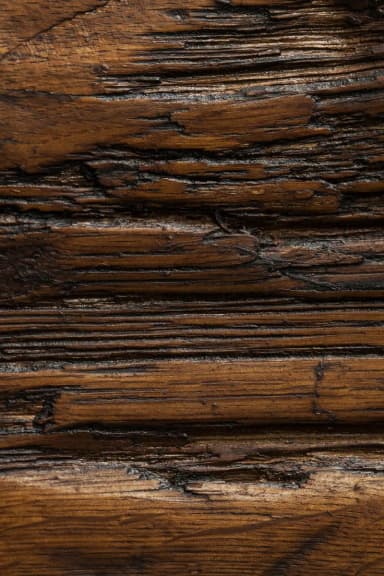
Reclaimed European oak aged over 200 years, shaped and graded by hand in Cheshire, as 10 mm solid overlays or 18 mm engineered platforms.
Let reclaimed oak soften the point

Cabin Wood
New engineered European oak in sandy greys and light browns, from the Natural Modern collection. Shown here in chevron.
Use colour to make the line cleaner

Bespoke European Aged Oak
New European oak tumbled with natural abrasives, available in plank, chevron and herringbone. Shown here in herringbone, in a Manchester renovation.
Set the chevron around the project
Make every point meet
The first point sets up every point that follows.
Set the axis before the first board
Chevron in our projects
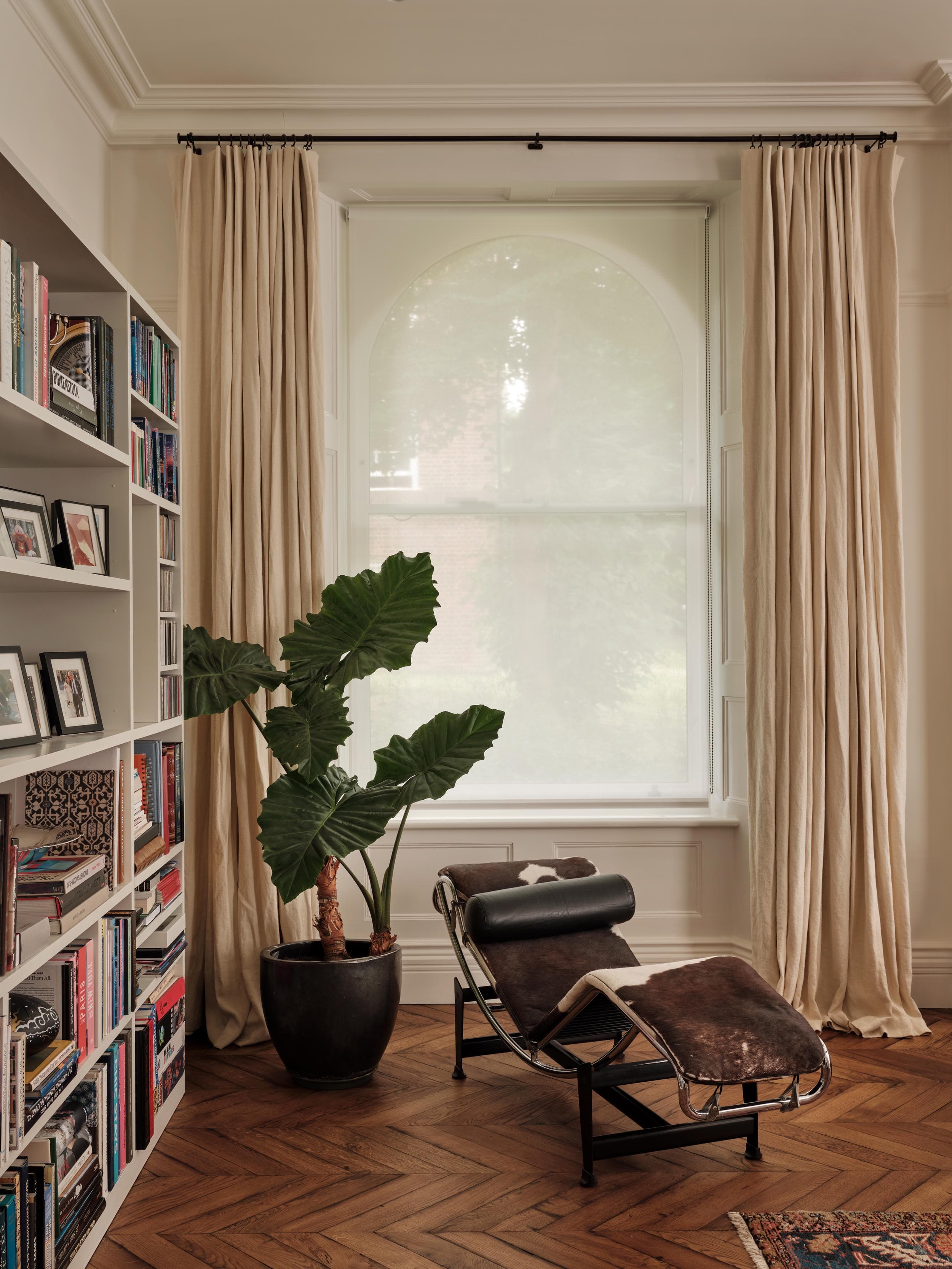

Highgate House, with Tom Rutt Studio

Explore the projects


Chevron beyond our projects
More parquet patterns


Chevron Flooring FAQs
What is chevron flooring?
Chevron flooring is a parquet layout made from timber pieces with mitred ends. Two rows meet point to point to form a continuous V. In French parquet terminology, the pattern is commonly called point de Hongrie.
Is chevron flooring the same as herringbone?
No. Chevron pieces have angled ends that meet at a point. Herringbone uses rectangular blocks, with the end of one meeting the side of the next at 90 degrees. The result is a continuous V in chevron and a staggered zigzag in herringbone. Chevron gives the cleanest continuous line; herringbone breaks it into staggered joints, so each block reads more independently; Versailles works at a larger scale again, read panel by panel.
What angle is used for chevron flooring?
Chevron is commonly made with 45-degree or 60-degree cuts, although historical and modern specifications vary. Roubo's 18th-century point de Hongrie was cut at 45 degrees. The angle changes the pitch of the V and has to be fixed before the pieces are made, so we confirm it for each collection and bespoke project at specification.
What is chevron engineered wood flooring?
Chevron engineered wood flooring combines the pointed chevron layout with an engineered board construction. A real wood wear layer is bonded to a more stable base rather than the piece being solid timber through its full thickness. Our Manoir Oak Chevron, for example, is available as an 18 mm engineered platform as well as a 10 mm solid overlay.
Can chevron flooring be used with underfloor heating?
Some chevron constructions can. Manoir Oak Chevron is compatible with underfloor heating in both its 10 mm solid overlay and 18 mm engineered formats. Other products should be checked against their construction, subfloor and heating system before specification.
Can antique oak be made into chevron?
Yes. We make chevron from reclaimed oak around 200 years old, including Manoir Oak and 18th Century Antique European Oak. The workshop task is keeping the mitred geometry accurate while retaining old grain, surface wear and tonal variation.
Are chevron hardwood floors always solid wood?
No. Chevron hardwood floors can be solid or engineered. "Hardwood" describes the timber, while "solid" and "engineered" describe its construction. We supply chevron in both formats across different collections.
Is chevron harder to install than herringbone?
Chevron needs a different set-out, because two mitred pieces must meet precisely at each apex and those points continue along a visible line. Installers normally work from a reference axis and use mirrored left- and right-hand pieces. Herringbone is also specialist parquet work, but its end-to-side rectangular joints create a different installation sequence.