


As one of the great designers and craftsmen of the twentieth century, George Nakashima is noted for his fundamental belief that every tree deserved a second chance at life. He came to wood late, and by an unlikely road.
The short answer
- Who was George Nakashima? A Japanese-American architect turned furniture maker (1905 to 1990), who built his workshop in New Hope, Pennsylvania.
- What was his philosophy? That a tree can be given a second life, and that the maker's job is to find the right use for every part of it.
- What is he known for? Free-edge tables, the butterfly joint and the Conoid chair and bench.
- Can you still buy his furniture? Yes. Nakashima Woodworkers still makes it in New Hope, and older pieces come up at auction.

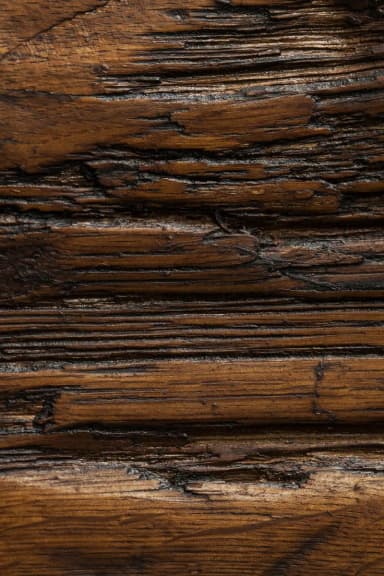
A reclaimed oak beam on the saw in our Cheshire workshop

What the saw uncovers: knots and grain in old timber
How did an architect become a woodworker?
Born in 1905 in Spokane, Washington, to parents who had recently immigrated from Japan, Nakashima took from his hiking and camping trips as a young Eagle Scout a love of trees and nature that stayed with him.
He studied architecture at the University of Washington, and in 1931, with a master's degree from MIT behind him, he sold his car and bought a round-the-world steamship ticket. By 1934 he was in Tokyo, working for Antonin Raymond, an architect who had collaborated with Frank Lloyd Wright on the Imperial Hotel and who combined Japanese forms with Western technology.
In the late 1930s Raymond's office sent him to Pondicherry in India to oversee Golconde, a dormitory for the ashram of Sri Aurobindo, which the Nakashima studio's own history calls the first reinforced concrete structure built in India. He became a disciple of Sri Aurobindo and was given the Sanskrit name Sundarananda, "one who delights in beauty". It was there that he made his first furniture.
What happened at Minidoka?
The war changed everything. In 1942, like others of Japanese ancestry, Nakashima was interned with his family at Camp Minidoka in Hunt, Idaho. There he met Gentaro Hikogawa, a carpenter trained in the Japanese tradition, who taught him to use traditional hand tools and joinery, including how to select timber and how to use a butterfly joint.
In 1943 Antonin Raymond sponsored his release and invited him to his farm in New Hope, Pennsylvania, to work as a chicken farmer. By 1945 he had opened a workshop in the garage of a cottage in the town, and in 1946 he bartered for land on Aquetong Road and began to build a shop and a furniture business. He also designed furniture lines for Knoll, including the Straight Back Chair, which brought his name to a larger audience and led to friendships with Harry Bertoia and Isamu Noguchi.

Slow, careful work at the saw

The long grain of a pale board
What was George Nakashima's philosophy?
While most woodworkers preferred furniture making with smooth and straight-edged lumber from the inner parts of a tree, he took pleasure in finding an ideal use for every part of it. In his book The Soul of a Tree he described wood as a material that "lives and breathes", and largely influenced by the Japanese idea of wabi-sabi he delighted in the beauty of imperfection. The work began at the log.
What is free-edge furniture?
A free edge is the natural outline of the tree, left where a straight saw cut would take it away. The tables that made Nakashima's name keep it: wide slabs with smooth tops and contours that, as Glenn Adamson writes for Sotheby's, "are found, not made". Nakashima often called his free-edge tables Minguren, a name that refers to vernacular craft.
In making furniture from slabs of wood, instead of hiding deep cracks and large gaps, he used the butterfly joint to hold the pieces together. The joint was used by others before him, but it became part of his craftsmanship. The final touches included an oil finish rather than veneers or lacquers, so as to highlight the natural grain of the wood.
He had no wish to see his furniture kept under glass, as the studio's history records.
"Furniture should be lived with and not treated as something overly precious. A certain amount of scratching and denting adds character to a piece."
We feel the same about a floor. Much of what we do at Re:claimed starts in the same place: an old board with its cracks and saw marks kept, and a finish that lets the grain show. The pale inlays across the slab of our Tova Table owe something to that long tradition of joinery too.

Pale inlays across our Tova Table

One of our oak parquet panels, every block its own
Where can you see his work?
The Smithsonian American Art Museum holds a Conoid Bench in the Renwick Gallery collection, and a Conoid Chair of 1971 in black walnut and hickory, built from a slab cantilevered over two legs. In 1986 he installed the first of his Altars for Peace at the Cathedral of St John the Divine in New York, and in 1983 he accepted the Order of the Sacred Treasure from Japan.
Nakashima died in 1990, aged 85. His daughter, Mira Nakashima, took over as creative director of Nakashima Woodworkers, making her father's pieces while developing her own, and in 2003 she published Nature Form & Spirit, a book about him. The house, studio and workshop in New Hope were designated a National Historic Landmark in 2014.
George Nakashima initially wanted to be an architect but instead became one of the world's renowned woodworkers. In his eyes, the tree was always where everything began, and it was up to the tree to dictate the form to follow.
We have written too about Axel Vervoordt and his love of imperfection, about reclaimed wood furniture, and about what reclaimed wood is.
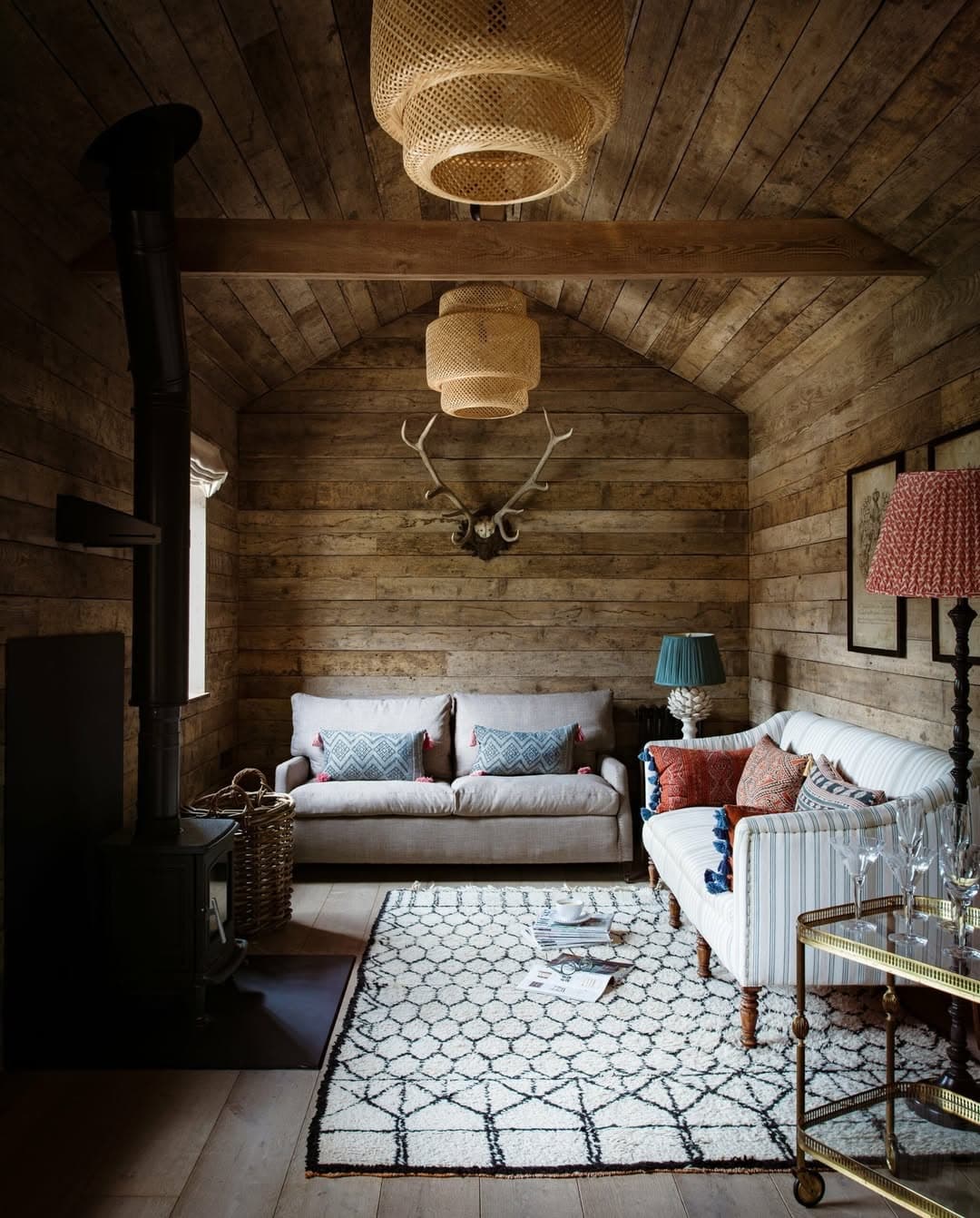
Old boards lining a barn renovation

Choosing a board in the workshop
George Nakashima FAQs
What was George Nakashima's philosophy?
That every tree deserves a second life. He looked for the right use for each part of a tree, kept its natural edge and flaws, and described wood as a material that "lives and breathes".
What is George Nakashima known for?
Free-edge tables made from wide slabs, the butterfly joint, and the Conoid chair and bench.
Where did George Nakashima learn woodworking?
He trained as an architect, made his first furniture in India, and learned traditional Japanese hand tools and joinery from the carpenter Gentaro Hikogawa at Camp Minidoka in Idaho.
What is a butterfly joint?
A small bow-tie-shaped piece of wood set across a crack or a join between two slabs, which holds them together and is left on show.
Can you still buy George Nakashima furniture?
Yes. Nakashima Woodworkers still makes pieces in New Hope, Pennsylvania, and older pieces appear at auction houses such as Sotheby's.
Re:sources
- Nakashima Woodworkers, Nakashima timeline.
- University of Washington Libraries, George Nakashima, Dream, Design, Build.
- Adamson G. (2023), George Nakashima: Life at the Edge, Sotheby's.
- Architectural Digest (2020), Object Lesson, on the Nakashima Woodworkers site.
- Smithsonian American Art Museum, Conoid Bench and Conoid Chair.
- Nakashima G., The Soul of a Tree: A Woodworker's Reflections, Kodansha International.
- Nakashima M. (2003), Nature Form & Spirit: The Life and Legacy of George Nakashima, Harry N. Abrams.


