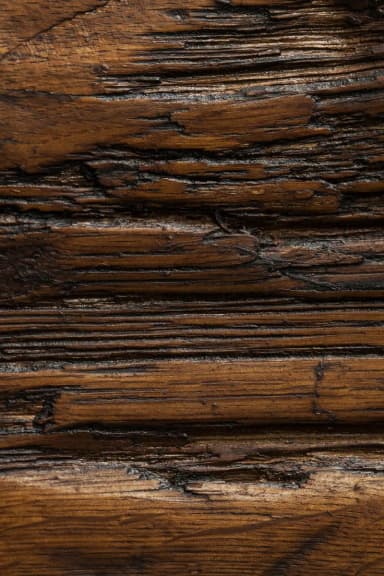




Knots and saw marks in reclaimed oak
The short answer
- Wabi-sabi is a Japanese way of seeing beauty in things that are imperfect, impermanent and incomplete.
- In wood, that beauty lives in the marks: knots, checks, grain, colour, wear and the traces of earlier use.
- Knots are where branches grew. Checks are fine splits that open along the grain as timber dries. Patina is what decades of light and touch leave behind.
- Reclaimed wood adds a second life to the first: nail holes, saw marks and the colour of the rooms it has known.
- At home, it means choosing materials that age well, and letting them.
What does wabi-sabi mean?
Wabi-sabi comes from Japan, from the tea ceremony and the rustic, handmade things that surround it. It is hard to translate and easy to recognise: a cracked bowl mended rather than replaced, a weathered gate, a floor that has softened under a century of footsteps. In his short book on the subject, written for designers, Leonard Koren puts it in a line.
Wood may be the most wabi-sabi of materials. It was alive, it keeps moving with the seasons long after it is cut, and it records everything that happens to it.
The marks in wood, and what they mean
Knots. A knot is the part of a branch that the trunk grew around as the tree thickened. Small, tight knots give a board rhythm; larger ones are often the point where the eye comes to rest. In English Pippy Oak, a distinctive pippy grain is the whole character of the floor.
Grain. Grain is the pattern of the wood's growth, read across the face of a board. Slow growth, fast growth, a lean towards the light: each one leaves its line, and no two boards share it.
Checks and cracks. Fine splits open along the grain as timber dries and moves. In a floor they are graded: small, stable checks are part of the surface, and anything that weakens a board is cut out.
Colour and patina. Light, air and touch deepen wood slowly, from the surface in. It is why a floor laid this year will look different, and often better, in ten.
Traces of a past life. In reclaimed wood, the marks of the first building stay: nail holes, saw and adze marks, the shadow of an old joist. Kiln-drying the timber kills any insects, and what remains is the record.

Grain: Saint Martin Jaune, from our Submerged Wood Collection

Knots: reclaimed Kanal pine

Patina: an antique oak Versailles panel

Colour: antique oak, close up
Imperfection is not the same as defect
Wabi-sabi is not an excuse for poor work. A floor full of character still has to be sound: dry, flat, free of rot and live insects, laid on a good subfloor and fixed properly. The craft lies in deciding which marks to keep. The American woodworker George Nakashima, who built his furniture around the shape of each plank, put that judgement at the centre of his work.
Our article on George Nakashima and his philosophy follows that idea further, and Axel Vervoordt shows how far it can go in a room.
Bringing wabi-sabi into a home
- Choose materials that age. Solid wood, lime plaster, linen and stone gain character with use; plastic and gloss lose it.
- Let the floor lead. A reclaimed or character-grade floor gives a room its texture, so the rest can stay quiet.
- Finish lightly. An oiled finish lets you feel the grain; a thick lacquer hides it. Our Mid-Century Pine, reclaimed from British and European interiors and up to 100 years old, carries two coats of hard-wax oil and no shine.
- Mend rather than replace. A worn board can be sanded and re-oiled; see our guide to removing scratches from wood floors.
- Leave space. Wabi-sabi rooms are uncluttered, so the few things in them can be seen.

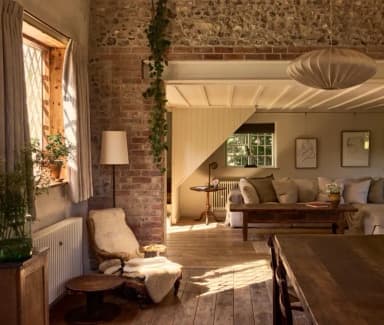
Our Mid-Century Pine at Alighieri, London

Our Mid-Century Pine at Church View

Wabi-Sabi and Wood FAQs
Are knots in wood a defect?
Not in themselves. A knot is where a branch grew. Sound, tight knots are part of a board's character and are expected in rustic and character grades; loose or decayed knots that weaken a board are graded out.
Why does wood crack as it dries?
Wood shrinks as it loses moisture, and it shrinks unevenly along and across the grain, so fine checks can open. Proper drying and acclimatisation keep movement small once the floor is down.
What is a wabi-sabi floor?
A floor that shows its material and its age: visible grain and knots, a matt or oiled finish, and the wear of use. Reclaimed oak and pine are natural choices.
Is wabi-sabi the same as rustic?
Close, but not quite. Rustic describes a look; wabi-sabi is a way of seeing, which values restraint and the passing of time as much as rough texture.
Re:sources
- Leonard Koren, Wabi-Sabi for Artists, Designers, Poets & Philosophers, Stone Bridge Press, 1994.
- George Nakashima, The Soul of a Tree: A Woodworker’s Reflections, Kodansha, 1981.
- USDA National Agricultural Library Thesaurus, knots.
- Re:claimed Journal, What Is Reclaimed Wood Flooring?.


