


It came in strapped and wrapped on pallets, and I will admit that the workshop stopped to look. We have been talking about this oak for months. We have drawn it, costed it and argued over it, and we showed the first of The Parisian Collection at Decorex in October, but there is nothing quite like seeing it stacked on your own floor.
So forgive the photographs. They are straight off my phone, taken between jobs, and I wanted to share them before anything gets tidied up.

Just in, still wrapped

Already two colours in one stack
It does not look like much at first
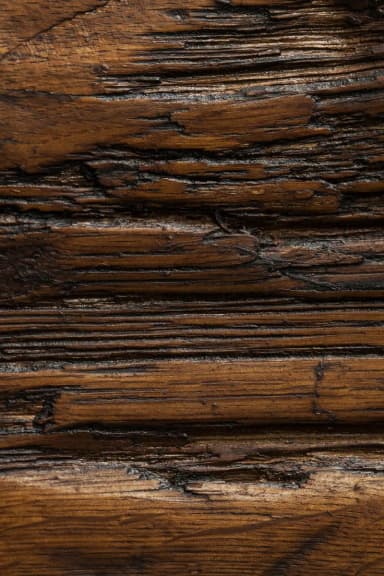
On the pallet this is rough, grey and unpromising. The ends are split and crusted, the faces are scarred, and you could be forgiven for walking straight past it.
That is rather the point. This is reclaimed oak from the farmlands of Europe, naturally aged by time and the environment, and years of sun and rain have done something to the surface that no stain and no workshop could ever fake.

The ends tell you everything

Nobody could draw this
Then you open it up
This is the moment I keep going back to. We split each board and one piece of wood becomes two: the weathered outer face, soft and silver grey, and the oak within, pale and warm and full of small knots and marks. One supply, two palettes.
I have been around wood for a long time, and that first cut still makes me stop and look.


The two faces, side by side

Every knot stays where it grew
Slow work, on purpose
Every board is graded by hand, then taken through the thicknesser and checked with callipers. Each piece is cut to its angle by hand, with no CNC and no laser, and the sanding is gentle, so the patina stays where it belongs.
The yellow sticker on the thicknesser promises more than 110 decibels, so nobody heard me asking them to hold still for a photograph.

Ear defenders on

Checked by hand

Through the thicknesser

Gentle on the patina
We are not looking for perfect precision here. A small gap, a slight change in height, the marks of the saw left across part of the surface: this is what stops a new floor from looking new.

The first panels
The first panels are already here, and we have started testing them. Each one is laid from the centre out on a jig, piece by piece, with the drawing pinned to the board behind it.

The first pieces go down

Laid out, drawing behind it
Turn a piece to its other face, change the finish or move to another layout, and you have a different floor.

Grey and weathered

Pale and quiet

Warm and deep

Darker in the grain
Colour, patina, layout: the combinations are close to endless, because every panel is bespoke, and we have barely started testing them.

The Star, with its drawing

Up to the light
Why we are so excited
The name comes from the great parquet floors of Paris, and that is the tradition this oak was made for: chevron, herringbone and panels such as Star and Chateau, laid out and made here in Cheshire, from wood that has already spent years outdoors. We had a warm reception at Decorex, and we came home with the Embracing Circularity Award, but seeing the first stock in the workshop is the part that makes it real.

Looking for the marks worth keeping

Light hands only
There is plenty more to come, and I will keep sharing it as it comes off the bench. If you would like to see where all of this is heading, The Parisian Collection is the place to start.
Robert Henry, Founder. Cheshire, November 2026.


