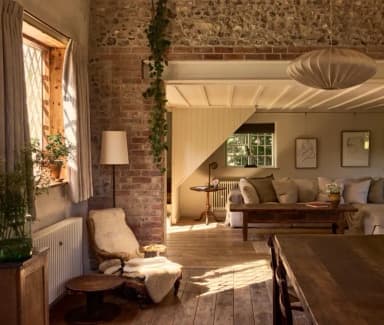




A chalet in Montana, where we supplied reclaimed pine
The short answer
- Biophilic design brings people into closer contact with nature indoors, through light, plants, views, materials and form.
- The evidence is encouraging and uneven. Daylight has the strongest case, and many studies are small or rely on what people report.
- Biophilic flooring means a real natural material whose grain you can see and feel, with a finish that does not bury it.
- New since 2024: the best-known guide to the subject has added a pattern, awe.
Biophilia: an old affinity
Erich Fromm wrote of biophilia as "the passionate love of life and of all that is alive". The biologist E. O. Wilson gave the word its present meaning in 1984: "the innate tendency to focus on life and lifelike processes". His book holds the line that designers still quote.
Our longer guide to biophilic design explains the principles. Here we stay with what has changed and what you can do at home.

The stair landing, lined with pale reclaimed pine

The terrace, open to the trees
What the evidence says
The figures most often repeated come from the Human Spaces report of 2015: people whose offices had greenery and sunlight reported 15% higher wellbeing, 6% higher productivity and 15% higher creativity. It was an online survey of 7,600 office workers in 16 countries, and it was published by a flooring manufacturer. It tells us how people felt, which is worth knowing. It can't tell us why.
Daylight has firmer ground. A study of 86,772 people in Nature Mental Health in 2023 measured light at the wrist. Those with the brightest days had about 20% lower odds of major depression than those with the dimmest, and those with the brightest nights had 30% higher odds. The authors point out that it may partly run the other way.
Wood was reviewed in 2020: nine randomised trials, 386 people. Longer exposure was generally followed by a better mood and a calmer body, "but the results are not entirely clear-cut". Plants lowered blood pressure in a 2022 review, and made no significant difference to attention.
So the honest case is a modest one. Some of what people feel in a room with daylight and natural materials can be measured. We set out the rest in being around wood and distance from nature.
Biophilic design at home
Let the day in. Clear the window before you enlarge it. Pull furniture back from the glass and hang curtains wide of the frame. Then make the nights dark.
Grow something you will look after. One large plant that thrives does more for a room than ten that don't.
Use natural forms. A curve, an arch, a board with its own edge. Our guide to natural patterns covers them.
Think past the eye. Wool and wood underfoot, the smell of oil on a newly waxed board, a window open to rain. Touch has a guide of its own.

Wide timber boards in a bathroom

Oak boards lit from the side
What is biophilic flooring?
It is a floor that keeps you in contact with a natural material. Terrapin Bright Green, whose 14 Patterns of Biophilic Design many architects use, advises designers to put real materials before synthetic ones, and warns that heavy paint, lacquer or polishing can hide what makes the material itself.
In practice, four things matter:
- A real surface. Wood, stone, cork or wool, and not a photograph of one.
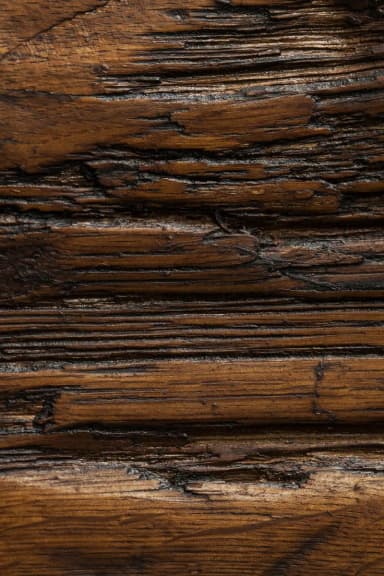
- Grain you can see and feel. Knots, rings and old saw marks are there for the hand as well as the eye.
- A finish that stays close to the wood. Ask to feel the sample as well as see it.
- Variation. No two boards the same, as in a wood.
A reclaimed floor has one more quality. Sun, rain and use have already worked on the surface before it reaches the room.
"Naturally aged wood bolsters biophilic design, connecting indoor spaces with the natural world." Andres Uprimny, Re:claimed
There is more in biophilia and reclaimed wood, and shops have a guide to themselves.

What is new in biophilic design
A fifteenth pattern. The anniversary edition of the 14 Patterns, published in 2024 and revised in April 2026, keeps its title and adds awe.
Nature as a requirement. The WELL Building Standard makes it a precondition: natural materials, patterns, shapes, images or sounds, with plants, water or a view of nature.
A last look at the Barbican Conservatory. London's best-known indoor jungle, with around 1,500 species, lists open dates until 3 January 2027, before a major restoration begins. Check the date before you go.

Reclaimed English oak herringbone, Gabriela Hearst, London
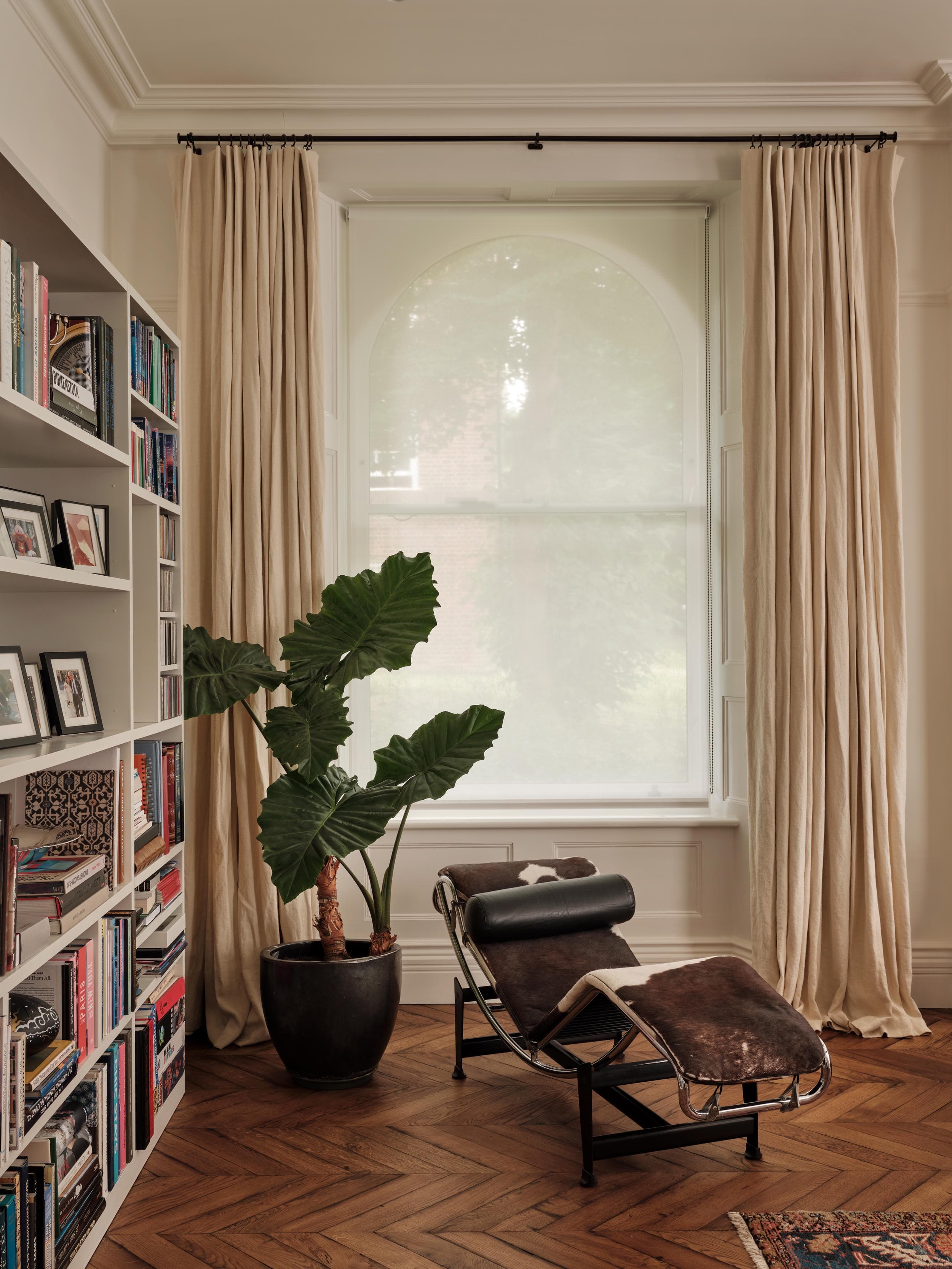
A reading corner on a Manoir Oak chevron floor, Highgate House
Biophilic design FAQs
What is biophilic design in simple terms?
Designing rooms and buildings so that people stay in contact with nature, through daylight, plants, water, views, natural materials and natural forms.
What is the best biophilic flooring?
A real natural material with a visible grain and a light finish. Solid or engineered wood, reclaimed wood, cork and stone all qualify.
How many patterns of biophilic design are there?
Fifteen in the current edition of Terrapin Bright Green's guide, which is still called 14 Patterns of Biophilic Design.
Does biophilic design really improve wellbeing?
There are signs that it can. Daylight has the strongest evidence. Studies of wood and plants are encouraging, smaller, and not always in agreement.
How can I start in a small flat?
Clear the windows, darken the bedroom at night, add one plant you will look after, and change one synthetic surface you touch every day for a natural one.
Re:sources
- E. O. Wilson, Biophilia, Harvard University Press, 1984
- Network in Canadian History and Environment, Erich Fromm's biophilia, 2023
- Human Spaces, The Global Impact of Biophilic Design in the Workplace, 2015, published by Interface
- A. Burns and others, Day and night light exposure are associated with psychiatric disorders, Nature Mental Health, 2023
- Review of randomised trials of wood and stress, 2020, and review of indoor plants, 2022
- Terrapin Bright Green, 14 Patterns of Biophilic Design, 2024, revised 2026
- International WELL Building Institute, WELL v2, Nature and Place
- Barbican Centre, Conservatory


