
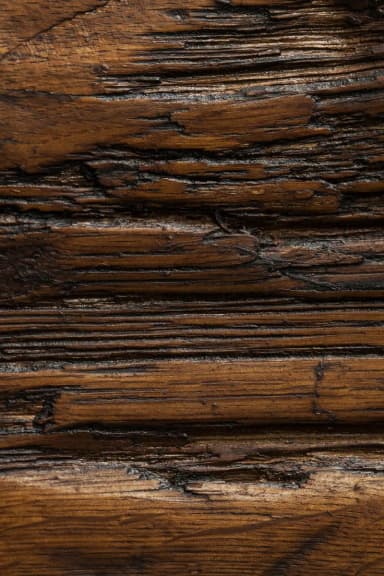




Our Reclaimed Wood
The short answer
- Meaning: "touch wood" is said after hoping for something, to avoid tempting fate. Americans say "knock on wood".
- Origin: nobody knows for certain. The Oxford English Dictionary traces it to the early 19th century and a British children's game called Tiggy-touch-wood.
- Science: in laboratory studies, touching uncoated oak with the palm calmed activity in the front of the brain and raised the body's "rest" response more than marble, tile or steel.
- Underfoot: a similar study found the same calming response when bare feet touched wood rather than marble.
- At home: unfinished or oiled wood keeps more of the feel of the grain than a thick, glossy finish.
What does "touch wood" mean?
You say it when you have just said something hopeful ("the weather should hold, touch wood") and want to avoid jinxing it. Many people tap a table or a door frame at the same time. In the United States the phrase is "knock on wood", and the gesture is a knock.
Where does "touch wood" come from?
The honest answer is that no one is sure. The most common stories are old ones: that knocking woke or thanked spirits living in trees, or that touching wood recalled the wooden cross. Folklorists find no firm evidence for either.
The written record is more recent. The Oxford English Dictionary traces "touch wood" only to the early 19th century and links it to Tiggy-touch-wood, a children's game of tag in which a player touching wood could not be caught. The folklorist Steve Roud traces the custom to that game. "Knock on wood" appears later, in American English. The habit may well be older than its first appearance in print.

Laid by hand

Finished by hand
What happens when we touch wood?
Researchers in Japan, led by Harumi Ikei and Yoshifumi Miyazaki, have measured it. In a 2017 study, eighteen female university students rested their palm for 90 seconds on plates of uncoated white oak, marble, tile and stainless steel while their brain and heart activity was recorded. Touching the oak calmed activity in the prefrontal cortex, at the front of the brain, more than any of the other materials, and raised parasympathetic activity, the body's rest-and-recover system, more than marble or steel. The authors describe it as physiological relaxation.
A second study the same year compared oak with different finishes. Uncoated wood had the calmest effect; oiled wood and a glass-like vitreous finish came next; a mirror-smooth finish had the least.
The feet respond too. In a 2018 study, nineteen female students placed the soles of their bare feet on a plate of hinoki cypress or of marble for 90 seconds. On the wood, prefrontal activity was calmer, the rest response stronger and the stress response weaker, and the students said they felt more comfortable, relaxed and natural.
These are small studies, of young women in Japan, over short periods, so they show a direction rather than a promise. They do match what most of us already sense: wood feels warmer and kinder to the hand than stone or metal.

Rustic reclaimed oak

Reclaimed Kanal pine

Antique European oak, unfinished

Chawari, from our Submerged Wood Collection
Bringing more touch into a home
- Choose a finish you can feel. Oiled and hard-wax-oiled floors keep the texture of the grain; heavy lacquers seal it away. Our guide to how often to oil a wood floor explains the care.
- Put wood where hands go. Handrails, door pulls, worktops and window sills are touched every day.
- Take your shoes off. A wood floor underfoot is warmer than stone and is meant to be felt.
- Mix textures. Rough and smooth, old and new: a reclaimed board beside linen and lime plaster asks to be touched.
There is more on this in the importance of tactility, quiet luxury and the senses and biophilic design.

Curved oak stair risers being made in our workshop

A curved reclaimed oak stair tread

Touch Wood FAQs
Why do people say touch wood?
To avoid tempting fate after saying something hopeful. It is a superstition, usually said half in jest, often with a tap on something wooden.
Is it touch wood or knock on wood?
Both. "Touch wood" is the British form; "knock on wood" is American.
Where does the saying touch wood come from?
Its origin is uncertain. The Oxford English Dictionary dates it to the early 19th century and a children's game, Tiggy-touch-wood, in which touching wood made you safe. Stories about tree spirits or the cross are popular but unproven.
Is touching wood good for you?
Small laboratory studies suggest it is calming: touching uncoated wood calmed brain activity and raised the body's rest response more than marble, tile or steel.
Does the finish on a wood floor change how it feels?
Yes. In one study, uncoated wood had the most relaxing effect and a mirror-smooth finish the least, with oiled wood in between.
Re:sources
- Ikei H., Song C., Miyazaki Y. (2017). Physiological Effects of Touching Wood. International Journal of Environmental Research and Public Health, 14(7), 801.
- Ikei H., Song C., Miyazaki Y. (2017). Physiological Effects of Touching Coated Wood. International Journal of Environmental Research and Public Health, 14(7), 773.
- Ikei H., Song C., Miyazaki Y. (2018). Physiological Effects of Touching the Wood of Hinoki Cypress with the Soles of the Feet. International Journal of Environmental Research and Public Health, 15(10), 2135.
- Evan Andrews, Why do people knock on wood for luck?, History.com.


