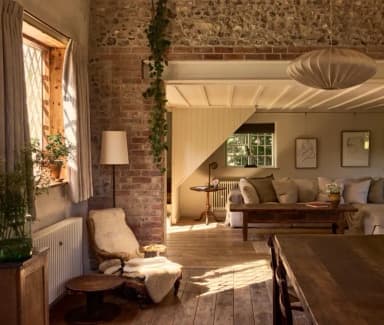




Reclaimed Mid-Century Pine at Church View, North Hampshire Downs
The short answer
- What it is: pine boards lifted from old buildings, cleaned, de-nailed and made ready for a new floor.
- Is pine a hardwood? No. It is a softwood, softer than oak, and its dents and scuffs become part of its charm.
- Which pine? Most old pine in British buildings is Baltic pine. Pitch pine is its American cousin, and often the harder of the two.
- Why reclaimed? Old pine grew slowly, and a century of use gives it a colour no new board has.
- Solid or engineered? Both exist, but in our range only engineered boards go over underfloor heating.
- What it costs: our Mid-Century Pine starts at £95 per m² unfinished and £125 finished, plus VAT and delivery.
Where Re:claimed began
Wood became Robert Henry's career in 2001, and it began with pine. Negotiating to reclaim the antique pine from a derelict Manchester mill, he went inside and found thousands of square metres of flooring scarred by bolt holes and metal plates, left by the machinery that once powered the cotton trade. With a £500 loan from his mother, he bought a batch of those Victorian boards.
Twenty-five years on we work in oak, parquet and joinery too, but pine is where it started.


Cotton mill flooring, lifted for reclaiming

The same character today: Mid-Century Pine
What is pine flooring?
Pine floorboards are cut from pine trees. In the past, builders made the most of how plentiful pine was, and of the wide, long boards it gave. New pine still comes in several grades to suit different budgets, which makes it a sensible choice. Old pine is another matter, and it is what most of this guide is about.
Pine is loved for its prominent grain and its knots, which give the boards a warm, rustic quality. It is softer than oak, so it takes dents, scratches and scuffs more readily. But one person's dent is another person's character, and on a pine floor the marks of everyday life are part of the appeal.
Is pine a hardwood or a softwood?
Trees are classed as hardwoods or softwoods by how they grow, not by how hard their wood is. Softwoods are conifers, like pine, spruce and fir; hardwoods are broadleaved trees, like oak, ash and walnut. So pine is a softwood, even though some pines are harder than some hardwoods.
How hard is pine flooring?
Softer than oak, and it varies a great deal by species. These are the Janka hardness figures from The Wood Database:
- European oak, for comparison: 1,120 lbf.
- Longleaf pine (Pinus palustris): 870 lbf, among the hardest pines.
- Pitch pine (Pinus rigida): 620 lbf.
- Scots pine (Pinus sylvestris): 540 lbf.
- Eastern white pine (Pinus strobus): 380 lbf, better suited to walls than to floors.
Douglas fir, at 620 lbf, is often sold beside pine, although it is neither a pine nor a true fir. Within any species, the heartwood at the centre of the tree is the darkest and hardest part, so a floor cut from heartwood resists dents better than one cut from the paler sapwood.

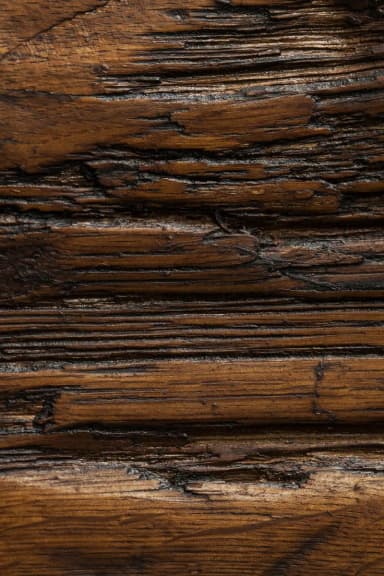
Old-growth pine, weathered over 75 to 150 years

The same wood on walls and floors, Montana
Types of reclaimed pine floorboards
Baltic pine. From the 17th century, softwood reached Britain from Norway and the Baltic, and after the Great Fire of 1666 it came in large quantities to rebuild London, according to The Building Conservation Directory. Architects such as Sir John Soane named the ports in their specifications, Memel and Riga among them. Historic England calls Baltic pine the "very durable timber found in most historic buildings that date from 1750-1900". This is Scots pine, grown slowly, and if you lift the carpet in a Georgian or Victorian house it is probably what you will find.
Victorian pine. The boards of the terraces, workshops and mills of industrial Britain, and the timber Re:claimed started with.
Heart pine. The American name for old longleaf heartwood, reddish brown and dense.
White pine. Pale, even and soft. At 380 lbf it marks easily, so it suits a wall or a quiet bedroom better than a kitchen.
What is pitch pine?
Pitch pine is a looser name than it sounds. To a botanist it is Pinus rigida, a minor American species. In the timber trade it may also mean longleaf pine, Pinus palustris, which is a good deal harder, so two boards sold as pitch pine may not come from the same tree.
Either way it is American, reddish brown at the heart, and darker than most Baltic pine. Salvage dealers find it most often in Victorian churches, schools and halls, as pews and as floors.
If you are offered pitch pine floorboards, ask which building they came from and how much of one batch there is. Then ask for a sample, because the colour and weight of a board in your hand will tell you more than the name on the invoice.

Why choose reclaimed pine?
The wood. Slow growth gives denser, finer timber, as The Wood Database notes of Scots pine from colder climates. Historic England warns that modern softwood "has a high degree of sapwood, which lacks natural durability". Old boards were cut from a different kind of forest.
The surface. Colour deepens with light and air, and a working life leaves bolt holes, nail holes and saw marks that no finish can imitate.
The forest. No new tree is felled for a reclaimed floor. Our note on the benefits of reclaimed wood sets out what that does and does not achieve.
The limits. Reclaimed pine is softer than oak, it moves a little with the seasons, and a second order may not match the first. If you want a floor without knots, cracks or old repairs, it is the wrong choice, and our comparison with new wood may help.
Our reclaimed pine: Mid-Century Pine
Our Mid-Century Pine carries that story forward: 100-year-old pine from Britain's historic cotton mills. Its colours are named after Ancoats, Blackburn, Bolton, Bury and Castlefield. Ancoats is pale and bleached; Bolton is the deepest and most traditional.
- Construction: 16 mm engineered, or 20 mm solid.
- Width and length: 180 mm as standard, in mixed lengths of mainly 2 to 2.4 m.
- Surface: brushed, with a slight undulation. Small cracks and holes are filled in a complementary colour.
- Finish: two coats of hard-wax oil, satin-matt, or unfinished for finishing on site.
Solid or engineered pine flooring?
A solid board is pine all the way through. An engineered board keeps the reclaimed surface and rebuilds it on a stable base, which is what lets old timber sit calmly in a modern house.
Engineered is the right choice over underfloor heating, and in our range it is the only one suitable. We recommend fully bonding the boards, and our guide to installation covers the methods.
How much does reclaimed pine flooring cost?
Our Mid-Century Pine is £95 per m² unfinished and £125 per m² finished, plus VAT and delivery, for the standard 180 mm plank. Samples are £25 and count as credit against a flooring order.
Loose salvaged boards can look cheaper by the metre, so compare the whole cost: waste, de-nailing, machining, finishing and a fitter who knows old timber. Our buyer's guide to reclaimed floorboards walks through it.
Finishing and staining pine floorboards
Pine's colour runs from nearly white and golden yellow to deep honey browns, and it darkens with age more than oak does. It takes a finish well, so the choice is mostly about how much of that change you want.
- Oil: hard-wax oil keeps the wood matt and can be refreshed over time. Our guide covers how often to oil a floor.
- White: a whitewash holds a pale tone as the boards age.
- Stain: try it on an offcut first, because knots and old repairs take colour differently.
- Paint: it changes the colour completely, though the grain still shows through.

Aged white patina, finished on site in Montana

Warm and oiled, at Church View

Pale and quiet, at Alighieri Jewellery, London

Painted dark, with the grain still showing
Restoring old pine floorboards
If you already have old pine under the carpet, the best course may be to do very little. The Society for the Protection of Ancient Buildings puts it plainly: "Old boards should never be sanded." On a board touched by beetle, it warns, sanding leaves "a ragged mess".
The same note says gaps "must be expected in an old house", and suggests slips of matching timber where they approach 5 mm. It also warns against levelling a floor in a house where everything around it has moved, because the flat floor is what will look wrong.
Many owners decide to sand all the same. If you do, use a specialist, and test any old paint first: the British Coatings Federation warns that surfaces painted before the 1960s could contain significant levels of lead, and that dust should be kept to an absolute minimum.
For missing boards, use old timber with a grain close to the original. New softwood will rarely sit quietly beside it.
Where does reclaimed pine work?
Almost anywhere that welcomes character.
At Church View in the North Hampshire Downs, two cottages and an old school hall became one family home, with pine running through the kitchen, sitting rooms and bathroom. Fred Rigby Studio chose Mid-Century Pine for the pale, light-filled room at Alighieri Jewellery in London.
And for a chalet in Montana, we sent unfinished Mid-Century Pine from Northern England across the Atlantic, to be finished on site with the designer Lori Faison in an aged white patina. The same timber, in another light, answers the mountains outside.

A bathroom at Church View

A kitchen in Montana
Reclaimed pine wall cladding
Pine is just as beautiful on walls. It gives a room texture and a quiet, rugged charm: a feature wall, an old wall brought back to life, or, if you are bold, a whole room.
Our reclaimed pine cladding is typically sourced from European country barns and farmhouses. It is 8 mm thick, in mixed widths and 750 mm lengths, in Silver or Brown, and it is made for walls and ceilings only, never floors. At Ichibuns in London, 320 m² of it wraps the room in a softly eroded surface. Ask us for samples.

Reclaimed pine cladding beside a bath

Silver reclaimed pine on the walls at Ichibuns, London
Reclaimed Pine Flooring FAQs
Is pine a hardwood?
No. Pine is a softwood, because it is a conifer. The terms describe the type of tree, not the hardness of the wood.
Is pine good for flooring?
Yes, where you welcome character. It is softer than oak, so it shows dents and scratches more, but a well-kept pine floor lasts for generations, and pine floors more than a century old are still in use in British homes.
What is reclaimed pine flooring?
Pine boards recovered from old buildings and prepared for a new floor. Our Mid-Century Pine is 100-year-old pine from Britain's historic cotton mills.
Is pitch pine good for flooring?
Yes. It is usually harder than Scots pine, and its colour is deeper. Because the name covers more than one species, judge a sample rather than the label.
Can reclaimed pine go over underfloor heating?
Our engineered Mid-Century Pine can. Our solid boards are not suitable.
Is white pine good for flooring?
It is pale and attractive but soft, at 380 lbf on the Janka scale against 1,120 lbf for oak, so it dents easily. It is better on a wall or in a quiet room.
Should I sand old pine floorboards?
The Society for the Protection of Ancient Buildings advises against sanding old boards. If you do sand, use a specialist and test any old paint for lead first.
Does pine flooring change colour?
Yes. Pine darkens and warms with age, more than oak does. A whitewash or a finish made for pale woods helps hold a lighter tone.
What is pine plywood flooring?
A sheet material made from layers of pine, usually laid beneath a floor rather than used as the finished surface.
Re:sources
- Historic England, Selecting Timber: Baltic pine and modern softwood.
- The Building Conservation Directory 2015: imported softwood in Britain.
- Society for the Protection of Ancient Buildings, Patching Old Floorboards.
- British Coatings Federation, Lead in Painted Surfaces.
- The Wood Database: Longleaf Pine, Pitch Pine, Scots Pine, Eastern White Pine, Douglas Fir and English Oak.
- Conifers Garden, Pinus rigida: the name pitch pine in the timber trade.
- Re:claimed, Mid-Century Pine Collection and Sustainability.


