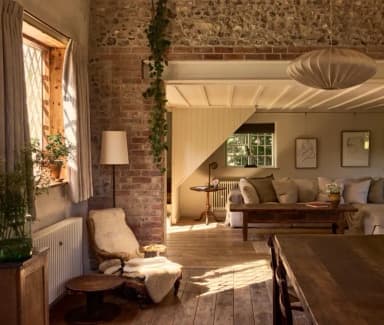
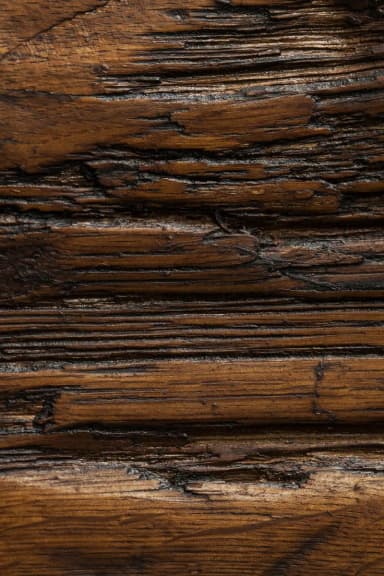




Reclaimed Mid-Century Pine, Church View
The short answer
- Less waste: old timber stays in use rather than being chipped, burnt or sent to landfill.
- No new tree: a reclaimed board needs no fresh felling.
- Stored carbon: the carbon locked in the wood stays there for another lifetime.
- Character: patina, saw marks and the colour of long use.
- Stable, seasoned timber: long years in a building have dried it thoroughly.
- Wide boards and long lengths: sizes that are hard to find in new wood today.
Reclaimed wood or recycled wood?
The two are often confused. Reclaimed wood keeps its form: the flooring of an old dockyard re-laid in a Docklands apartment, a roof beam turned into a mantelpiece. It is lifted out, cleaned and de-nailed, and goes on being timber.
Recycled wood usually loses its form. Most of it is chipped, and the chips go to make panelboard or to fuel biomass plants. So both keep wood out of landfill, but only one keeps the board.
Where does waste wood go?
The Wood Recyclers' Association estimates that the UK produces about 4.5 million tonnes of waste wood a year. In 2025, around 2.5 million tonnes went to large-scale biomass and about 930,000 tonnes to panelboard.
In England and Wales, the law sets out the order in which waste should be handled: prevention first, then preparing for re-use, then recycling, other recovery and, last of all, disposal. Reclaiming a board sits near the top of that list. Burning it sits near the bottom.

Reclaimed French oak boards, wide and weathered

The same pine by the fire, Church View
The environmental benefits of reclaimed wood
It keeps timber in use. Around 80% of the timber we work with at Re:claimed is reclaimed. Each floor made from it is wood that has already been grown, felled and seasoned.
It needs no new felling. Choosing a reclaimed board means that no new tree is cut down for it. New wood can be a responsible choice too, when it comes from certified forests.
It keeps carbon stored. Dry wood is about half carbon by weight, and that carbon stays in the board for as long as it stays in use. Our article on embodied carbon sets this in context.
It is worth being honest about the limits. Reclaimed wood still has to be collected, transported, de-nailed, dried and milled, so it is not free of impact. What it does avoid is the felling.
The benefits for a floor or a room
Character. This is what brings most people to reclaimed wood. Its colour, wear and marks are the record of a real past. Re:claimed began with marks like these: in 2001 our founder, Robert Henry, went inside a derelict Manchester mill to negotiate for its antique pine, and found thousands of square metres of flooring scarred by bolt holes and metal plates, left by the machinery of the cotton trade.
Seasoned, settled timber. Much of the wood used in buildings from the 18th to the early 20th century came from slow-grown trees, and slow growth often means a tight, close grain. Long years in a building have dried it thoroughly. Once it has been prepared it is stable and hard-wearing, though like all wood it still moves a little with the humidity of a room.
Wide boards and long lengths. Old buildings hold sizes and timbers that are hard to find in new wood, such as wide pine boards and long oak planks.
A sense of place. A reclaimed floor brings a story with it, and it will go on gathering its own. Designers and architects choose it for that as much as for the material, and it takes hard use: Ichibuns, a busy Japanese burger bar, stands on 350 m² of our Reclaimed Hand-Finished Heritage Oak.

Cotton mill flooring, lifted for reclaiming

Patina mixed by hand, in our workshop

Beyond the floor
The same wood serves well in other parts of a house.
- Panelling and cladding: old boards can go on walls as well as floors, as with our reclaimed white pine cladding.
- Staircases and joinery: treads, risers and handrails in the same reclaimed oak as your floor.
- Furniture: tables, cabinets and worktops, each one different.
Is reclaimed wood worth it?
For most people who love it, yes, but go in with open eyes. Prepared reclaimed wood usually costs more than new, supply is limited to what each building gave up, and a second order may not match the first. Our comparison of reclaimed and new wood sets out when each is the better choice.

Reclaimed oak parquet panel

Reclaimed white pine wall cladding
Reclaimed Wood Benefits FAQs
What are the main benefits of reclaimed wood?
Less waste, no new felling, carbon kept in store, character that only time can give, and seasoned timber in sizes that are hard to find new.
What is the difference between recycled and reclaimed wood?
Reclaimed wood is reused as timber, so it keeps its form as a board or beam. Recycled wood is usually chipped and turned into panelboard or fuel.
Where does recycled wood go?
In the UK, mostly to biomass plants and panelboard mills. Those are the two largest outlets in the Wood Recyclers' Association's figures for 2025.
Is reclaimed wood stronger than new wood?
Not automatically. Strength depends on the species, the grade and the condition of the board, not on age alone. For anything structural, ask a qualified engineer to assess it.
Is reclaimed timber furniture worth it?
If it is well made, yes. You pay for the material's age and the time taken to prepare it, and you are left with a piece nobody else has.

Re:sources
- Re:claimed Journal, What Is Reclaimed Wood Flooring?.
- Re:claimed Journal, Is Reclaimed Wood Better than New Wood?.
- letsrecycle, Waste wood processing fell 7% in 2025: the Wood Recyclers' Association figures.
- The Waste (England and Wales) Regulations 2011, regulation 12: the waste hierarchy.
- Forest Research, The carbon content of trees.
- Re:claimed, Sustainability.


