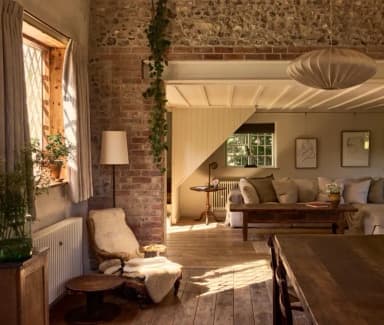
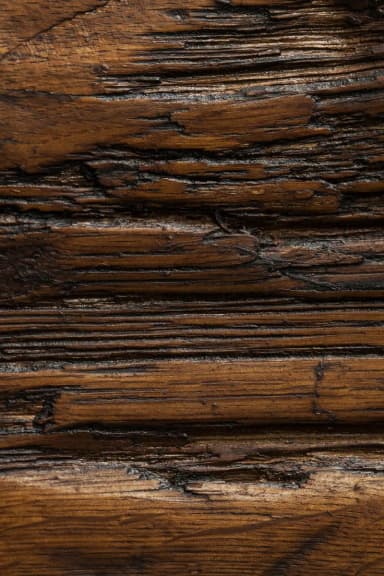



Reclaimed wood is timber taken from old buildings, barns, warehouses and other structures, prepared and used again. It has become a popular choice for floors, walls and furniture, for its look and for its lower impact.
Like any material, it has drawbacks as well as strengths. Before you choose it for a home or a workplace, it helps to know both.
The short answer
- Pros: character from a long life (patina, nail holes, saw marks), a lower carbon cost than new timber, and long-seasoned wood that releases far fewer natural volatile compounds than freshly sawn boards.
- Cons: quality varies from one source to the next, boards need careful preparation, large matching quantities can be scarce, and it often costs more than new timber.
- The supplier makes the difference: sorting, drying, de-nailing and milling decide whether a reclaimed floor performs.

Manoir Oak chevron through a living room in Highgate, by XUL Architecture

Manoir Oak running through a family room in the same house
Pro: a history you can see
Each reclaimed board has a past. It may have been a floor in a house, a beam in a barn or part of a warehouse. That life shows in the wood: the patina, the weathered surface, the old nail holes and saw marks. New timber cannot copy those marks, because they were made by time and use.
That is what gives a reclaimed floor its warmth.

Old nail holes and saw marks, kept in the finished plank

The split, weathered ends of oak boards from old buildings
Pro: a lower carbon cost
Reusing wood that has already been cut means fewer new trees felled for the same floor, and less waste sent to landfill or burned. It is reuse in its simplest form, and it fits the idea of a circular economy.
The difference can be large. A life-cycle study by the US Forest Service found that new wood flooring carried roughly five times the climate impact of reclaimed flooring.
Pro: long-seasoned wood, cleaner air
Freshly sawn timber gives off natural volatile compounds: mostly terpenes in softwoods, and much smaller amounts of aldehydes and acetic acid in hardwoods such as oak. These emissions fall sharply as wood dries. Reclaimed boards have had decades to dry, so they release far less. Our post on indoor environments and health looks at the wider picture.

Wide pale boards and a timber-clad ceiling in a double-height room
Pro: a different kind of beauty
Knots, nail holes, colour changes and saw marks give a reclaimed floor depth that a uniform board does not have. It suits a rustic room, an industrial one or a quiet contemporary one equally well, and it never looks quite like anyone else's floor.
Is reclaimed wood stronger?
Not as a rule. Many reclaimed softwoods come from slow-grown trees with tight growth rings, which tends to mean denser timber. In oak, it works the other way: wider rings generally mean denser wood, because the open band of each ring stays about the same width. What matters most is that the boards are sound and well prepared.

Pale reclaimed Mid-Century Pine boards with a book and a woven rug

Honey-toned reclaimed pine boards up close
Con: quality varies
Reclaimed wood comes from many different buildings, so its condition varies from one source to the next. Some boards are sound and straight; others are split, worn or full of old fixings. Sorting them takes time and an experienced eye.
Con: it needs careful preparation
Before it can be laid, reclaimed timber has to be de-nailed, cleaned, dried to the right moisture content and milled to a consistent size. Done well, this turns a pile of old boards into a floor that can be used for generations. Done badly, it shows. This work is the main reason to buy from a specialist.
Con: availability and lead times
A particular species, width or colour in a large quantity can be hard to find, because the supply depends on what buildings come down and when. Large projects may need longer lead times.

A reclaimed wood floor under velvet chairs in a restaurant

Wide brown oak boards along a kitchen table
Con: it often costs more
Reclaimed wood often costs more than new timber, because finding, salvaging and preparing it takes skilled time. Rarity, quality and the work involved all affect the price. For many people the character and the lower impact make it worth it.
Care and maintenance
A reclaimed floor needs the same care as any wood floor: regular cleaning, a suitable finish, and occasional maintenance coats. How often depends on the finish. Our guide to aftercare for a waxed floor explains the routine for waxed floors.
What to ask a supplier
- Where does the wood come from, and what was it before?
- How is it dried, and to what moisture content?
- Is every nail and fixing removed before milling?
- Can you see a sample, or a floor already laid?
In short
Reclaimed wood brings history, character and a lower carbon cost to a room. Its drawbacks (variable quality, preparation, availability and cost) are real, and they are exactly where a good supplier earns its place.
FAQ
Is reclaimed wood more expensive than new wood?
Often, yes. Salvaging and preparing it takes skilled time, and rare species or widths cost more again.
Is reclaimed wood safe indoors?
Properly prepared reclaimed wood is a good indoor material. Long-dried timber releases far fewer natural volatile compounds than freshly sawn boards. Ask how the wood has been cleaned and treated.
Does reclaimed wood warp?
Any wood moves with humidity. Reclaimed boards that have been dried to the right moisture content and milled properly are as stable as new ones.
Is reclaimed wood better for the environment?
Reusing timber avoids felling new trees for the same floor. One US Forest Service study found new wood flooring had about five times the climate impact of reclaimed flooring.
Re:sources
- Pohleven, J., Burnard, M. D. & Kutnar, A. (2019). Volatile organic compounds emitted from untreated and thermally modified wood. Wood and Fiber Science, 51(3).
- Kovacevic, M. et al. (2022). Emissions of volatile organic compounds from wood during drying. European Journal of Wood and Wood Products.
- FAO. Management of wood properties in planted forests (working paper).
- Bergman, R., Gu, H., Falk, R. H. & Napier, T. R. (2010). Using reclaimed lumber and wood flooring in construction: measuring environmental impact using life-cycle inventory analysis. USDA Forest Service.


