


The short answer
- There is plenty of wood. The UK produced about 4.5 million tonnes of waste wood in 2025. Most of it was chipped or burned for energy.
- Little is reclaimed as wood. Surveys of the UK trade show the volume of reclaimed timber falling sharply since 1998.
- The scarce part is slow-grown timber in long lengths and large matching batches.
- The limit is mostly human: time to take a building apart carefully, and a trade to store and sort what comes out.
- For a project, start early, choose the wood from samples and be open about the mix.
What happens to the UK's waste wood
According to the Wood Recyclers' Association, as reported by letsrecycle, about 4 million tonnes of waste wood were sent for reuse, recycling or recovery in 2025. Roughly 2.5 million tonnes went to biomass energy and 927,000 to panel board. Animal bedding, equestrian surfaces and reuse shared about 300,000 tonnes between them, although reuse grew by 12% in the year.
Where somebody sorts the wood by hand, the picture changes. The Community Wood Recycling network collected 20,983 tonnes in 2025 and reused 36% of it. So the material is there. What decides its future is whether anyone looks at it before it reaches the chipper.

Floorboards lifted in a cotton mill

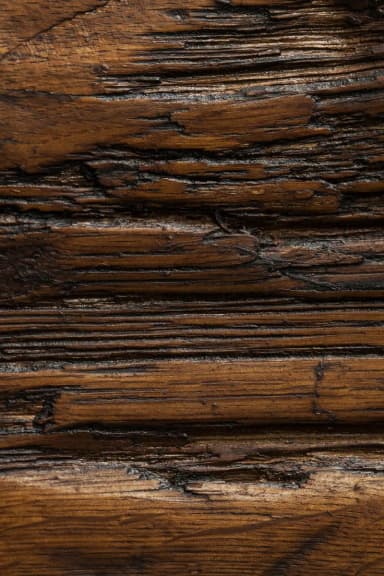
The rough ends of reclaimed oak boards
Is there less reclaimed wood than there was?
There seems to be, at least in the trade. Salvo's surveys put the UK's reclaimed timber at 3.8 million cubic metres in 1998, 1.9 million in 2007 and a provisional 120,000 in 2020. The surveys were not done in the same way, so the direction matters more than the exact numbers. A 2024 study from University College London reached the same conclusion, that the amount of wood reclaimed "has decreased significantly in the last decades".
Across north-west Europe, the FCRBE reuse project found that only 1% of building elements of any kind are used again after their first life.
None of this means the buildings have gone. The University College London researchers name the barriers plainly: the time it takes to dismantle a building, the logistics, and the lack of an established supply chain. Deconstruction, taking a building down piece by piece, is slower than demolition, and somebody has to pay for that time.

A brick cotton mill. Our Mid-Century Pine comes from Britain’s historic cotton mills
Where reclaimed wood comes from
Most reclaimed wood has already lived one life in a building. Ours comes from barns, farmhouses, factories and civic buildings across Europe and the United States. The boards of our Mid-Century Pine collection come from Britain's historic cotton mills.
There is a second source, less known in Britain. When a valley is flooded to make a reservoir, the forest in it can stay standing under the water for decades. Our guide to sunken, submerged and bog wood explains how it differs from a log on a riverbed.
Each of these sources is an alternative to felling and processing a new tree. The UK Government's 2026 conversion factors put new construction wood at 269.5 kg of carbon dioxide equivalent per tonne and re-used wood at 38.5 kg, about 86% lower. Those are general figures for construction timber, not for a finished floor, and we look at the detail in the environmental impact of wood flooring.

Cutting a reclaimed oak beam in our Cheshire workshop

Measuring stacked oak boards
What really is scarce
Writing in the Building Conservation Directory, Jonathan Boulting called historic material "a dwindling resource", and much of what is salvaged from old buildings is no longer available from any other source. A pine board cut from a slow-grown tree in the nineteenth century cannot be ordered again.
Size and quantity are the other limits. The FCRBE project describes how often dealers in north-west Europe can supply a uniform batch of reclaimed solid wood flooring:
- Up to 50 square metres: frequent.
- 50 to 100 square metres: occasional.
- 100 to 250 square metres: rare.
For structural beams, lengths of up to eight metres are common, longer ones are rarer, and larger orders usually need a lead time. A large house in a single wood, from a single building, is the hardest request of all.
How the same wood goes further
- An engineered board. A solid beam can be cut into reclaimed top layers and laid on a stable base, so one old beam covers more floor than it would as solid boards.
- A pattern. Herringbone and parquet use short lengths that a plank floor would leave behind.
- A mix. Boards from several buildings can be graded and toned together until they read as one floor.
- Another life. A solid plank can usually be sanded or planed several times, and lifted and laid again. Historic boards need more care, so take advice before sanding them.

Planning a project around reclaimed wood
Architects and designers often pass on one worry from their clients: will there be enough? These steps help.
- Ask early. Give the area, the room heights and the date, even if the design is still moving.
- Choose from samples, and ask how much of that batch exists. Our sample boxes are made to order.
- Order it together. A second batch, bought a year later, will come from another building.
- Allow for cutting, and keep some boards back for repairs.
- Decide what must match. A hall and a drawing room can be one wood; a bedroom floor can come from another.
Our guide to buying reclaimed floorboards covers the questions to ask a supplier.


Reclaimed Estate Oak under a hall table

Reclaimed French oak in a kitchen diner
Frequently asked questions
Is reclaimed wood a finite resource?
Historic timber is, because old slow-grown trees and the buildings made from them cannot be repeated. Wood that has already been used is not scarce: the UK produces about 4.5 million tonnes of waste wood a year.
Is reclaimed wood getting more expensive?
We have not found a reliable price index, so we would not claim it. Price depends on the species, the width and length of the boards, the condition and the work needed. Our comparison of reclaimed and new wood explains where the cost goes.
Can reclaimed wood be reclaimed again?
Yes. A wood floor can be lifted, cleaned and laid in another room or another house, if it was fitted in a way that lets it come up without breaking.
Is all reclaimed wood old?
No. The word describes a second use and says nothing about age. Ask what the wood was, where it came from and what is known about it.
Re:sources
- letsrecycle, Waste wood processing fell 7% in 2025, June 2026, reporting the Wood Recyclers' Association
- Community Wood Recycling, Annual Report 2025
- Salvo for FCRBE, Yours truly, reclaimed, 2021
- FCRBE, Solid wood floors and Reclaimed structural timber, 2021
- TU Delft, FCRBE project
- University College London, study of reclaimed wood in the UK, 2024
- J. Boulting, Salvage and sustainability, The Building Conservation Directory, 2015
- UK Government, Greenhouse gas reporting: conversion factors 2026


