


The short answer
- Embodied carbon now matters as much as energy use, and interior finishes and fixed furniture count towards it.
- Reuse of materials is the clearest way to cut that carbon, and the evidence for reclaimed wood is strong.
- Biophilic design stays, with a more honest reading of what the research shows.
- Indoor air is judged by what materials give off, not by how many plants are in the room.
- Green claims are regulated: vague words like "eco-friendly" now carry legal risk in the UK and the EU.
- Durability is the quiet trend underneath all of them: the lowest-carbon floor is the one you never replace.
1. Embodied carbon is now part of the brief
Buildings and construction account for around 37% of global carbon dioxide emissions and nearly half of all material extracted from the earth, according to the United Nations Environment Programme's 2025-2026 global status report. It calls embodied carbon, the carbon spent making and moving materials, "a critical, and still under addressed, climate challenge".
Interiors are part of that sum. The Royal Institute of British Architects' 2030 Climate Challenge counts finishes and fixed furniture in its embodied carbon target, which for a new home is below 625 kg of carbon dioxide equivalent per square metre by 2030. The target is voluntary, as is the UK Net Zero Carbon Buildings Standard published in March 2026, but both are now written into briefs, and EU rules already require new buildings to disclose their life-cycle climate impact.

A reclaimed oak beam cut for a second life in our Cheshire workshop

Reclaimed boards, stacked and waiting to be worked
2. Reuse before anything new
The simplest way to keep embodied carbon low is to use a material that already exists. A US Forest Service life-cycle study compared new and reclaimed wood: making virgin framing timber took about 11 times the energy of reclaiming it, and virgin wood flooring about 13 times, with a global warming impact about three and five times greater.
The same thinking now shapes whole fit-outs. In a UK Green Building Council case study, an office in Manchester saved 38% of its upfront embodied carbon against a standard fit-out by reusing what was there and designing out what was not needed. For a floor, reuse is literal: oak that has already stood for a century or two in a barn, a mill or a manor is cut, graded and laid again. Our reclaimed wood floors start there, and our piece on the environmental impact of wood flooring sets out what the numbers do and do not include.

3. Biophilic design, read honestly
Biophilic design, bringing natural light, materials and patterns into buildings, remains one of the strongest ideas in interiors. Terrapin Bright Green's 14 Patterns of Biophilic Design names "material connection with nature" as one of them: real wood, stone and natural fibres in place of imitations.
The research is promising but careful. A 2020 review of nine studies with 386 participants found that seeing wood indoors "may improve certain indicators of human stress", and called for more research. That is a good reason to choose real materials, and a reason to describe the benefit as a possibility, not a promise. We have written more on biophilic design and on biophilia and reclaimed wood.

A reclaimed wood worktop, finished for a kitchen

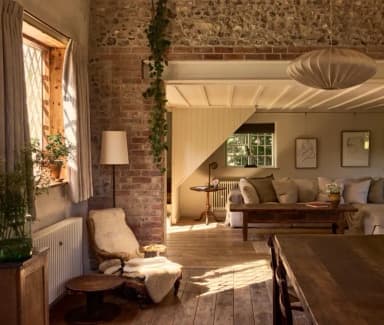
Wide reclaimed boards under a brick attic wall
4. Cleaner indoor air starts with the materials
House plants are often sold as air purifiers. The evidence says otherwise: a 2019 review found you would need between 10 and 1,000 potted plants per square metre of floor to remove volatile organic compounds as fast as ordinary ventilation already does.
What changes indoor air is what the materials give off. The WELL Building Standard, version 2, limits volatile organic compound emissions from at least 90% of the flooring in a project, by cost or area, using recognised test methods such as the European EN 16516. For a designer that means asking for emissions test results on floors, finishes, adhesives and paints, rather than relying on a label.
5. Honest green claims
The words around a sustainable interior are now regulated. The UK Competition and Markets Authority's Green Claims Code asks that claims be truthful, clear, complete, fair in comparison, based on the full life cycle and backed by evidence, and warns that terms like "green", "sustainable" or "eco-friendly" used without explanation risk breaking the law. Since April 2025 the authority can rule on breaches itself and fine a business up to 10% of its global turnover. In the EU, from 27 September 2026, generic environmental claims without proof of excellent performance are banned, and so are claims of a neutral or reduced impact based on carbon offsetting.
For designers this is useful, not only a constraint: specify materials whose story can be shown, with a source, a life-cycle figure or a document behind it.

6. Durability is the trend underneath
Every one of these trends leads to the same place. A floor that lasts for generations, can be sanded and refinished, and can be lifted and used again at the end, keeps its carbon locked away and spares the next one from being made. Reclaimed oak has already proved that once. Our piece on whether reclaimed wood is better than new compares the two.

Timber prepared by hand in the workshop

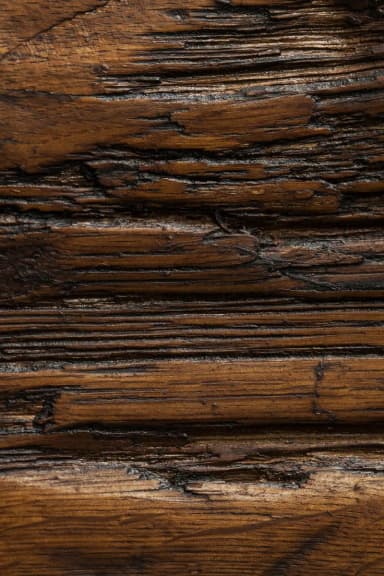
Reclaimed oak: weathered faces below, paler oak above
Frequently asked questions
What are the main sustainable interior design trends in 2026?
Counting embodied carbon, reusing materials, biophilic design based on honest evidence, low-emission materials for cleaner indoor air, regulated green claims and choosing durable materials that last.
Is reclaimed wood more sustainable than new wood?
A US Forest Service life-cycle study found that producing new wood flooring took about 13 times the energy of reclaiming it, with about five times the global warming impact. The result depends on the source and transport, so ask for the details behind any claim.
Do house plants clean indoor air?
Not in any useful amount. A 2019 review found that 10 to 1,000 plants per square metre would be needed to match normal ventilation. Low-emission materials and good ventilation matter far more.
What counts as embodied carbon in an interior?
The carbon spent making, transporting and installing materials. The Royal Institute of British Architects includes finishes and fixed furniture in its embodied carbon targets.
Can I call a product eco-friendly?
Only with evidence. Under the UK Green Claims Code, vague terms like "eco-friendly" without explanation risk breaking consumer law, and in the EU generic environmental claims without proof are banned from 27 September 2026.
Re:sources
- United Nations Environment Programme and GlobalABC, Global Status Report for Buildings and Construction 2025-2026: Key Messages
- Royal Institute of British Architects, 2030 Climate Challenge
- UK Net Zero Carbon Buildings Standard, version 1, 2026
- Competition and Markets Authority, Green Claims Code; new consumer protection regime, 2025
- Directive (EU) 2024/825, Empowering Consumers for the Green Transition
- International WELL Building Institute, WELL v2, VOC restrictions
- Cummings and Waring, Potted plants do not improve indoor air quality, Journal of Exposure Science and Environmental Epidemiology, 2019
- Bergman, Gu, Falk and Napier, Using reclaimed lumber and wood flooring in construction, USDA Forest Products Laboratory, 2010
- Terrapin Bright Green, 14 Patterns of Biophilic Design, 2014
- Lipovac and Burnard, Effects of visual exposure to wood on human affective states, Indoor and Built Environment, 2020
- UK Green Building Council, JLL Manchester office fit-out


