

The short answer
- Parquet is any wood floor made of small pieces laid in a repeating geometric pattern, as opposed to boards running in straight lines.
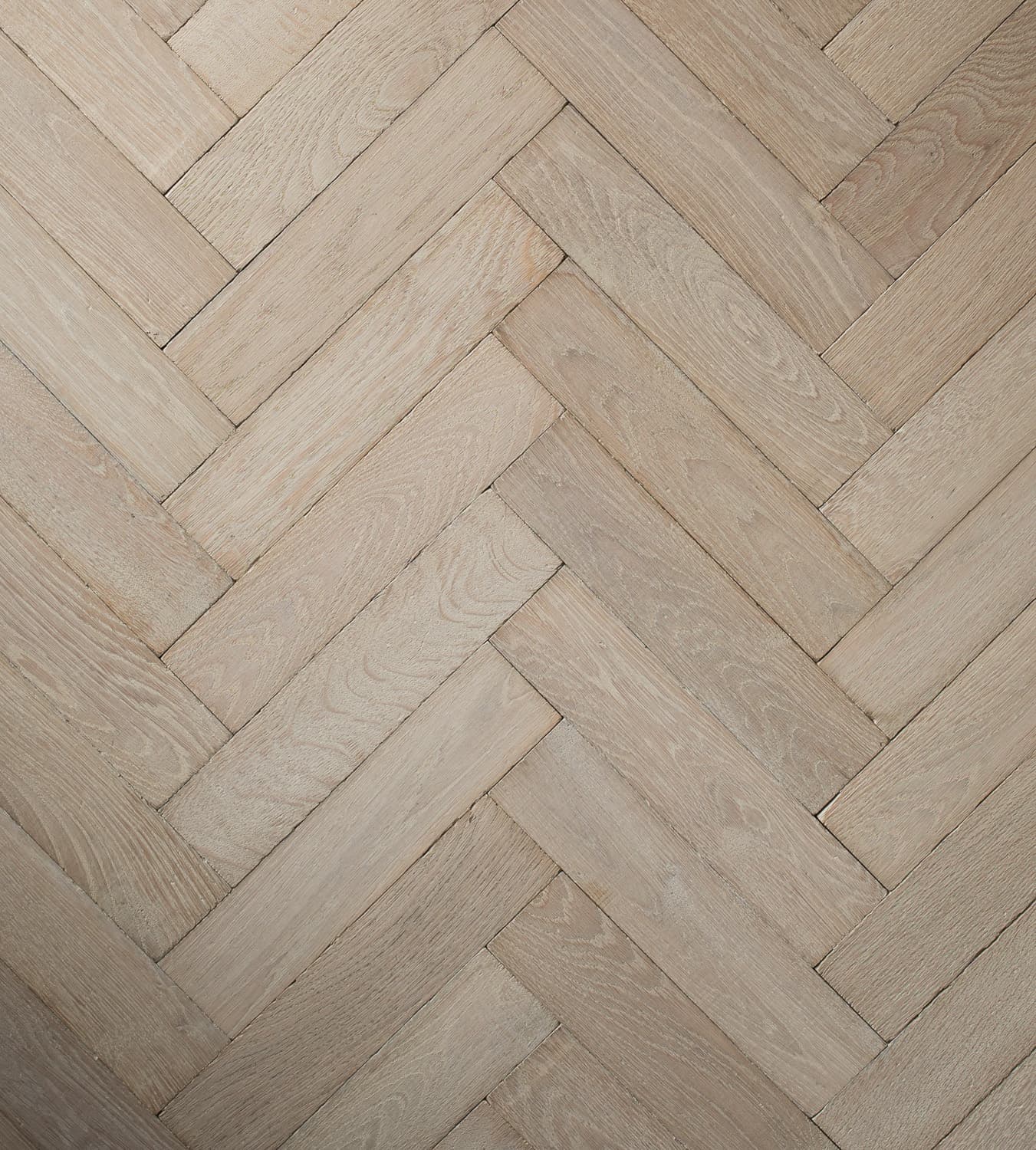
- Herringbone is one parquet pattern: rectangular blocks with square ends, the end of one meeting the side of the next at 90 degrees.
- Chevron is another: the ends are cut at an angle, usually 45 or 60 degrees, so the blocks meet point to point in a continuous V.
- Versailles is parquet made as square panels, introduced at the Palace of Versailles in 1684.
- All three can be laid in reclaimed or new oak, solid or engineered.
Is herringbone parquet?
Yes. The National Wood Flooring Association defines parquet as "any pattern that is geometric in shape as opposed to linear", and lists herringbone and chevron among those patterns. Herringbone is one of its patterns, not an alternative to it, so "herringbone or parquet" is not really a choice between two floors. It is a choice of pattern within one way of making a floor.
The word itself is French, the diminutive of parc, a small enclosed space. A parquet floor is built from many small pieces rather than long boards, and the pattern they make is what gives it a name. Our guide to what parquet flooring is covers the family in more detail.

Herringbone and chevron: the cut makes the difference
In herringbone, every block is a plain rectangle. The blocks are laid at right angles to each other, so the end of one meets the side of the next and the rows step past each other in a broken zigzag. Because the pattern runs in a direction, herringbone blocks are made as left-hand and right-hand pieces.
In chevron, the ends of each block are mitred, most often at 45 or 60 degrees, and two rows meet point to point. The zigzag becomes one clean V running down the room. French joiners call it point de Hongrie.

Herringbone: square-ended blocks, here in Hand Made French Oak

Chevron: mitred ends meeting point to point
In a room the difference is one of rhythm. Herringbone has a broken, layered rhythm that settles a space; chevron draws a cleaner, more directional line that leads the eye along a hall or towards a window. If you are choosing between the two, our piece on whether a herringbone floor is a good idea weighs them side by side, and the herringbone and chevron pages show the floors we make in each.

Versailles: parquet made as panels
Versailles parquet is laid as repeating square panels. Inside each square, straight and diagonal oak pieces are framed into an interlaced geometry, and the panels are then laid edge to edge.
The pattern takes its name from the palace. Large diagonal squares, now called parquet de Versailles, were introduced there in 1684 to replace marble floors that needed constant washing, which tended to rot the joists beneath. The château's own restoration documents still describe rooms floored in "parquet à panneaux de type Versailles". We draw our Versailles panels at 707, 570 and 660 mm.

A Versailles panel in Hand Made French Oak, unfinished

An antique European oak Versailles panel
Older than Versailles
Parquet did not begin at Versailles. In the Gallery of Francis I at Fontainebleau, the panelling, seats and floor were installed before 21 October 1539, when the craftsman Scibec de Carpi received his final payment for them. Parquetry reached England in the 17th century with Queen Henrietta Maria, and our history of French parquet follows it from there.
The herringbone shape is older still, though not in wood: the Romans laid bricks and stone in the same zigzag, a technique called opus spicatum, mostly for pavements.

Gustave Caillebotte painted the other side of the story in 1875. Les Raboteurs de parquet, now in the Musée d'Orsay, shows three men on their knees planing the floor of a Paris apartment by hand, the shavings curling around them.
Why reclaimed oak suits these patterns
Every one of these patterns is made from short pieces, and every piece shows its face. That is where old oak earns its place. Our Manoir Oak is reclaimed European oak aged over 200 years, shaped and graded by hand in Cheshire, and laid in chevron. Our 18th Century Antique European Oak, reclaimed largely from historic French and wider European structures, is cut for herringbone. Our antique Versailles panels are made from old French oak beams.
The colour, the nail holes and the uneven wear of a reclaimed block change from piece to piece, and a geometric pattern lets that variation read as part of the design rather than a flaw.

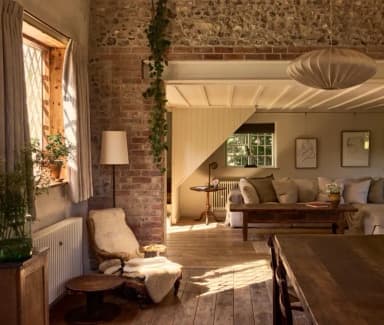
Bespoke European Aged Oak herringbone in a Manchester living room

Manoir Oak chevron through a Highgate family home
Solid or engineered parquet
Parquet can be solid wood all the way through, or engineered: a hardwood top layer bonded to a core of plywood or softwood. Engineered construction is more stable when the air or the subfloor changes. Some engineered constructions can go over underfloor heating, but that depends on the product, its thickness, the subfloor, the heating system and the way it is fitted, so it is a question to settle at specification. Our Manoir Oak chevron, for example, comes as 10 mm solid overlays or 18 mm engineered platforms.

Frequently asked questions
What is the difference between herringbone and parquet?
Parquet is the type of floor: small pieces of wood laid in a geometric pattern. Herringbone is one of those patterns. Every herringbone floor is a parquet floor, but not every parquet floor is herringbone.
Is chevron the same as herringbone?
No. Both are parquet patterns made of rectangular blocks, but herringbone blocks have square ends and meet at right angles, while chevron blocks are cut at an angle at each end and meet point to point in a continuous V.
What angle is chevron cut at?
Most often 45 or 60 degrees, although historical and modern specifications vary.
Where does Versailles parquet come from?
From the Palace of Versailles, where large diagonal oak squares were introduced in 1684 in place of marble floors.
Can parquet go over underfloor heating?
Some engineered parquet can. Whether a particular floor can depends on the product, its thickness, the subfloor, the heating system and the installation method.
Re:sources
- National Wood Flooring Association, Installation Guidelines (2026): nwfa.org
- Vassar College, Rosso Fiorentino catalogue: the construction and decoration of the Gallery of Francis I
- Fiske Kimball, The Creation of the Rococo (1943), on parquet de Versailles in 1684
- Musée d'Orsay: Gustave Caillebotte, Raboteurs de parquet, 1875
- Re:claimed: herringbone flooring, chevron flooring, Versailles flooring


