


An office floor has a harder life than a floor at home. It takes more feet, more chair castors and more cleaning, it usually sits on a concrete slab, and it often has to go down over a weekend because the business cannot stop. Engineered wood answers all three of those better than a solid board does, which is why it is what we specify for almost every commercial project we take on.
The short answer
- Is engineered wood good for an office? Yes, and for most offices it is the better of the two. It is steadier than solid wood over a heated slab, and it can be glued straight down to concrete.
- What makes it suit a workplace? It arrives prefinished, so nobody is sanding and oiling on site while people are trying to work.
- How long does it last? That is decided by the top layer of real timber, not by the total thickness of the board.
- What about a home office? A single room is the easy case. The question there is the subfloor, not the traffic.

What engineered wood flooring actually is
An engineered board is made in layers. A layer of real timber on top, and underneath it a core of plywood, glued with the grain running at right angles between layers. That cross-grain construction is the whole point: it holds the board steady as the air around it dries out and damps down again through the year, where a solid board of the same width would move more.
Ours are built on a European birch-ply core, bonded with a WBP waterproof adhesive. The plank thicknesses we make are 12, 16 and 20 mm: a 12 mm board is 3 mm of oak on 9 mm of ply, and a 16 mm board is 4 mm of oak on 12 mm of ply. There is more on choosing between them in our guide to engineered wood flooring thickness.
It is a real wood floor. It is not laminate, and it is not a photograph of timber under a wear coat.


Our Traditional White in the games room at Miniclip

The same floor through the canteen
Why it works over a concrete slab
Most offices are built on concrete, often with underfloor heating in it, and that is where the two kinds of floor part company. A solid board over a heated slab is working against its own nature: the heat cycles pull moisture out of it, and a wide solid board will tell you about it at the joints.
All of our engineered floors can be glued down, and that is how the 12 and 16 mm boards go in, bonded over plywood, flooring-grade chipboard or concrete. Only our 20 mm engineered boards are nailed, which is what you need over joists or battens. We do not float our floors at any thickness. A floated floor is a more temporary way of fitting, and it sounds like one underfoot, which matters more in a quiet office than it does in a hall at home.

Reception at The Aircraft Factory, where the floor meets brick, steel and glass
The other thing a slab gives you is a flat, continuous surface across a whole floorplate, which is why engineered boards can run unbroken from the lifts to the far window. A long, wide board needs that flatness to sit properly, and it is the main reason open-plan offices read so calmly in wide plank rather than in narrow strip.

Prefinished boards, and the weekend
This is the part that decides most commercial jobs, and it has nothing to do with how the floor looks.
Engineered flooring is almost always supplied prefinished, which takes sanding and finishing off the site programme altogether. On a solid floor finished in place, the building has to be empty while the floor is sanded, and empty again while each coat goes on and cures. Prefinished boards are laid, and that is the end of it. For a working office that is the difference between a long shutdown and a weekend.
The same applies afterwards. If a board gets damaged by a dropped monitor, a leaking plant pot or a badly behaved chair, a single plank can be lifted and replaced in a glued floor without touching the rest of the room.
What the research on wood in offices actually shows
This is worth being careful about, because the wellbeing claims made for wood flooring are usually much larger than the evidence behind them.
The study that does exist is a good one. In 2010 David Fell, at the University of British Columbia, put 119 people through four different office setups, crossing the presence of wood with the presence of plants, and measured their autonomic nervous systems. Wood lowered sympathetic nervous system activation, measured through skin conductance: the same system that fires when you are under stress. Plants, in that study, did not, and there was no combined effect.
What that is: a careful laboratory study, on students, in a room dressed as an office, finding a measurable physiological difference. Fell himself says more research is needed. What it is not: evidence that a wood floor reduces sick days or pays for itself in productivity. We have seen both claims made, including in the earlier version of this page, and neither follows from the work.
So the honest version is the modest one. There is real evidence that a room with wood in it reads as calmer to the body than the same room without it. That is a reasonable thing to want in a workplace, and it is not a business case on its own.

Herringbone going down over a plywood subfloor

A meeting pod built as a timber shell

Reclaimed pine cladding around a meeting room

A meeting booth lined in pale reclaimed pine
Cleaning, dust and allergens
Hard floors are easier to keep clean than carpet, and that is the sensible way to put it.
Allergy UK's guidance on house dust mites is to remove carpeting where possible, to remove carpet from concrete floors in particular, and to vacuum hard floors regularly with a high-filtration vacuum cleaner. Mites, it notes, live in bedding, carpets, soft furnishings and clothing. That advice is written for the home rather than the workplace, but the reason it gives carries across: a hard surface can actually be cleaned, and a carpet holds what lands on it.
What we would not claim is that a wood floor is hypoallergenic. It is a surface that shows dust and lets you remove it, which is a different and more useful thing. In an office with soft seating and fabric screens, the floor is one part of the answer.

Specifying for an office: what to ask for
- The wear layer, not the total. The top layer of timber is what a sanding takes from. The National Wood Flooring Association puts a traditional sand at about 0.8 to 1.6 mm and advises against sanding a wear layer thinner than about 2.4 mm, so a 3 mm top layer clears that line and 4 mm leaves more in hand.
- How it will be fixed. Glued to a flat slab, 12 or 16 mm is enough. Over joists or battens, it is 20 mm.
- The finish. Matt and satin hide traffic better than gloss, and a brushed or hand-scraped surface hides it better again. In an entrance or a lift lobby that is not a style decision.
- Board width and length. An engineered core carries wider and longer boards than a solid floor can, which suits open-plan space, where narrow boards read as busy across a big room.
- The paperwork. We are FSC® certified under C109654, and our sustainability page sets out what that covers. On a tender, ask for the certificate code rather than the word.
And for a home office
A home office is the easy version of this, and it is worth separating out, because the answer changes.
One room, one person, a chair that moves a few times a day. Traffic is not the problem. The subfloor is: a study over joists upstairs wants 20 mm nailed, and a converted garage or a ground-floor room on a slab wants 12 or 16 mm glued. If the room has a lot of glazing, which home offices often do, engineered is the safer specification for the same reason it is in a conservatory: the board sits steadier through the swings in temperature and humidity.
On the question of whether engineered wood is any good under a desk: the only thing a desk asks of a floor is that castors do not chew it. Felt pads or a hard-castor mat solve that on any wood floor, solid or engineered.

A breakout room at Miniclip before the furniture went in

Desks beyond the table-tennis table, on the same floor
Our own office projects
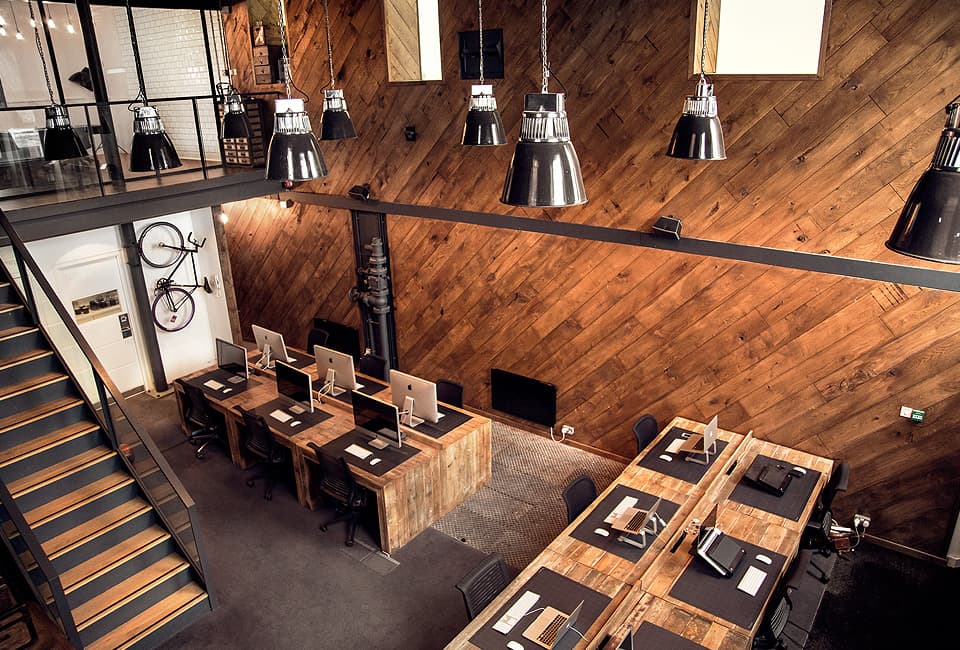
The floors on this page are all ours, in working offices. Our Traditional White went into the Miniclip headquarters, Our New Orleans into the Ubiquitous offices in Manchester, Our Molasses Patina into a London advertising agency, and a wide oak floor onto a City trading floor. They have been down for years, which is the only durability test that means anything.
If you are specifying for a workplace, our concierge service covers sampling, lead times and site sequencing, and we can supply and fit or supply only.
Engineered Wood Flooring for Offices FAQs
Is engineered wood flooring good for offices?
For most offices, yes. It is more stable than solid wood over a concrete slab or underfloor heating, it can be glued straight down, and it arrives prefinished so the floor does not hold up the building.
What is the best flooring for a home office?
A wood floor suits a home office well, because the traffic is light and the room is usually one you also want to sit in. Choose the thickness by the subfloor: 20 mm nailed over joists, 12 or 16 mm glued over a slab or plywood.
Can engineered wood flooring be used over underfloor heating?
Yes. Ours are built on a birch-ply core for exactly that, and the floor surface is kept to 27°C or below. Our underfloor heating guide sets out how the system should be run.
How long does an engineered floor last in a commercial space?
Longer than the fit-out around it, in our experience, but the figure that matters is the wear layer rather than a number of years. A 3 to 4 mm top layer can be sanded and refinished, which is what gives a commercial floor a second and third life.
Is engineered wood flooring real wood?
Yes. The surface is a layer of real timber. It is not laminate, which is a printed image under a wear coat.
Does a wood floor make an office healthier?
There is real evidence that a room containing wood lowers sympathetic nervous system activation compared with the same room without it, from a 2010 study at the University of British Columbia. That is a measurable physiological effect in a laboratory. Claims about sick days and productivity go well beyond what has been shown.
Re:sources
- David Fell, Wood in the Human Environment: Restorative Properties of Wood in the Built Indoor Environment, PhD dissertation, University of British Columbia, 2010.
- Allergy UK, House Dust Mite Allergy.
- Brett Miller, National Wood Flooring Association, How many times can a wood floor be sanded?, Hardwood Floors, 2025.
- Our own engineered wood flooring, thickness guide and sustainability pages.


