


Engineered flooring is a board made in layers: a core of plywood, glued together, topped off with a layer of real timber. The layers run at 90° to one another, which keeps the board steadier than a solid one as the air around it changes. Ours are built on a European birch-ply core, bonded with a waterproof adhesive.
When deciding on the thickness, the right choice can make a huge difference to the end result, though the number on the label is rarely the whole story.
The short answer
- How thick is engineered wood flooring? Most boards are somewhere between 12 and 20 mm. Ours come in 12, 16 and 20 mm, with thicker parquet panels.
- What is the best thickness? The one that suits how the floor will be fixed. Over joists we use 20 mm, and thinner boards are glued to a flat subfloor.
- What decides how long it lasts? The top layer of timber, far more than the total.
- What about underfloor heating? Our 12 and 16 mm planks are both suitable, with the floor kept to 27°C or below.

What do the numbers mean?
An engineered board has two numbers that matter: the total thickness, and how much of that is real timber. Here is how they fall across what we make.
- 12 mm: 3 mm of oak on 9 mm of ply, in our Originals and Provenance floors.
- 15 mm: herringbone and chevron blocks in those same collections.
- 16 mm: 4 mm of oak on 12 mm of ply, in our Originals, Provenance and Driftwood floors.
- 18 mm: the engineered platform of our Manoir Oak chevron.
- 20 mm: the engineered boards we can nail, and the thickness of our solid floors.
- 22 mm: the panels in The Parisian Collection, a 10 mm oak wear layer on 12 mm of ply.

A 12 mm engineered floor in a kitchen extension

Cabin Wood engineered oak, laid in chevron
Does a thicker floor last longer?
Not by itself. Certain areas in the home get a constant beating from heavy traffic and can experience a lot of wear and tear, especially if you have kids and pets: the kitchen, the hallway, the living space. What those rooms use up is the top layer, and the plywood underneath never sees daylight.
The National Wood Flooring Association puts it plainly: "the primary determinant of how many times a wood floor can be sanded is the thickness of the wear layer". A traditional sand removes about 0.8 to 1.6 mm, and the association advises against sanding a wear layer under about 2.4 mm. A 3 mm top layer clears that line and a 4 mm layer gives you more in hand. Between them the floor's flatness and the skill of the person sanding it decide the rest, so it is worth having a specialist look before anyone starts.

How does the fixing method decide the thickness?
For us this is usually the first question. All of our engineered floors can be glued down, and that is how the 12 and 16 mm boards go in, over plywood, flooring-grade chipboard or concrete. Only our 20 mm engineered floors are nailed, over existing floorboards, plywood, flooring-grade chipboard, joists or battens. We don't float our floors at any thickness, because floating is a more temporary way of fitting and an antique floor is always fully bonded.
So a board that seems a little thin can be exactly right on a flat concrete slab, and quite wrong on joists.

Our engineered oak running from room to room

The same floor carried into the bathroom
Will the floor be fixed directly to the joists?
If you are planning to fit your engineered wood floor directly on to joists or battens, you can expect more pressure to be put on the boards, so this is where the thicker board earns its place. We only nail 20 mm engineered floors, and on joists they go down with 50 mm nails into every joist or batten. The grooves at the end of each board support it, so the boards don't have to end on a joist.
The spacing of the joists matters too. If they are widely spaced you may need noggins and braces to offer more stability, or a plywood deck. That is a question for your fitter or structural engineer, on your own floor, before the boards are ordered.
What is the best thickness over underfloor heating?
Many homeowners opt for engineered wood flooring if they already have, or are planning to install, underfloor heating. Engineered boards are generally more stable than solid wood floors, and the thinner the floor, the less stands between the heat and the room, as the thickness of the material affects the heat output.
Our 12 and 16 mm planks, 18 mm Manoir chevron and 22 mm panels are all suitable, so thickness is seldom what rules a floor out. The limits lie elsewhere. The floor should never exceed 27°C, the system should be tested and running for two weeks before fitting begins, and the screed has to be properly dry. We do not recommend electric heating mats, because the heat is transferred too quickly.
Before any selection, pay attention to the manufacturers' guidelines, and seek the advice of your supplier and heating installer.

Does floor height matter?
In a renovation, the deciding number is sometimes the height of the floor next door. A thinner board, with its adhesive, can meet an existing threshold or stone floor without a step and without taking anything off the doors. Measure the finished height before you choose, including whatever sits beneath the boards.

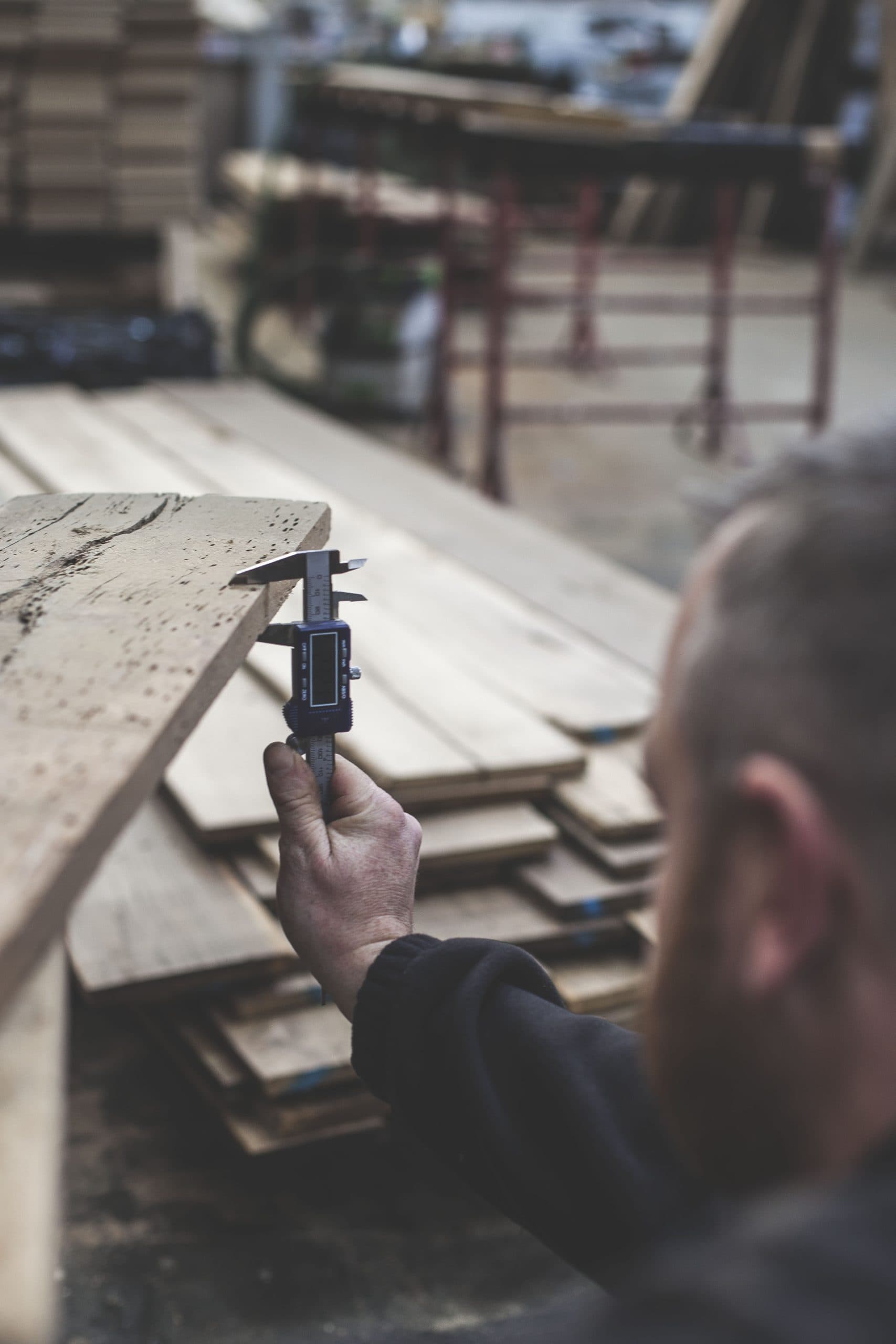
Cutting to size in our workshop

Bespoke European Aged Oak herringbone, Manchester
If you are still weighing up the two kinds of floor, we have written about engineered and solid wood flooring and engineered and solid parquet. Do ask us about the right build for your project, and see our engineered floors.
Engineered Wood Flooring Thickness FAQs
How thick is engineered wood flooring?
Usually between 12 and 20 mm. Our planks are 12, 16 or 20 mm, our engineered herringbone and chevron blocks are 15 to 18 mm, and our panels are 22 mm.
What is the best thickness for engineered wood flooring?
It depends on the fixing. Glued to a flat subfloor, 12 or 16 mm is enough. Nailed, or over joists, we use 20 mm.
What thickness of engineered wood is best for underfloor heating?
Our 12 and 16 mm planks are both suitable, and thinner boards let the heat through a little more easily. Keep the floor at or below 27°C.
Can engineered wood flooring be fitted directly to joists?
Yes, if it is thick enough. We nail only 20 mm engineered boards to joists or battens, into every joist.
What is a good wear layer thickness?
Enough to sand. Sanding is not advised under about 2.4 mm, so our 3 and 4 mm oak layers leave room to refinish.
Is 12 mm engineered wood flooring thick enough?
Yes, when it is glued to a flat, sound subfloor. It suits rooms where height is tight, but we would not fix it to joists.
Re:sources
- Miller B. (2025), How many times can a wood floor be sanded?, Hardwood Floors.
- Carless N. (2007), Underfloor heating: the cover up, NBS.
- Re:claimed, Installation explained.
- Re:claimed, Underfloor heating explained.
- Re:claimed, The Originals Specification Manual, edition 01.

Our Molasses Patina at the Grey ad agency


