


"Hardwood" sounds like a claim about toughness. It is a claim about botany, and the difference matters when you are choosing a floor.
The short answer
- Hardwood comes from broadleaved, flowering trees (angiosperms), whose seeds are enclosed, the way an acorn is. Softwood comes from conifers.
- Hardness is a tendency, not the definition. Most hardwoods are harder than most softwoods, but balsa, one of the softest woods there is, is a hardwood.
- Oak is a hardwood, and it has been the flooring hardwood of Europe for centuries.
- A hardwood floor simply means a floor whose wearing surface is one of these woods, whether the board is solid or engineered.
The most common hardwoods are oak, walnut, beech, maple, alder, teak, hickory and mahogany. How hardwoods and softwoods differ in practice is its own subject; the short version is that the labels describe the tree, not the performance of your floor.

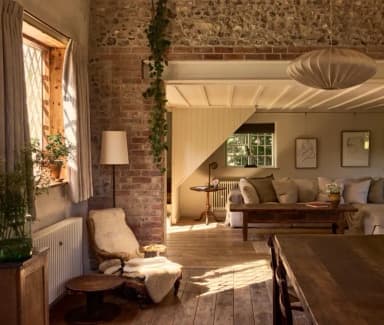
Our European oak in the Chesneys Haverstock showroom
European oak, the flooring hardwood
European oak has been a valued flooring species across centuries, associated with history, longevity, durability and strength.
Traditionally the oak was of native origin. As demand has grown, European oak is now mostly sourced from well-managed, sustainable woodlands of Croatia, France and Germany.
Mountain-grown oak is strong, heavy and durable, and because the tree grows at a steady, regular pace, its character is evenly distributed through the wood. Like reclaimed oaks from at least the last century in Europe, slower-grown oak has a tighter grain and a more stable structure. And only wood with a significant amount of tannin takes our hand-made, custom finishes the way oak does.

Solid European Mountain Oak

Solid European Mountain Oak, music room
Why hardwood floors endure
A hardwood floor captures the beauty of nature and brings it indoors; it is a connection between an interior and the natural world. Styles and trends have shifted around it for generations, and it has outlasted all of them.
Every board is unique. Each species carries its own grain, hue and character, and within a species no two boards repeat. Over time the floor acquires subtle shadings of colour, small marks and dents, the kind of character that can only be earned over years and that gives an interior its sense of permanence.

Durability is the other half of the argument. A hardwood floor that is properly dried, made, installed and finished can be sanded and refinished several times without losing its integrity, which is why oak floors are passed down rather than replaced. Care and maintenance decide how gracefully it ages.

Sustainability
The demand for environmentally responsible choices keeps rising, and rightly so. Hardwood grown in an ecologically sound way is a renewable material with a long life and a quiet footprint, and schemes such as the Forest Stewardship Council® exist to hold forestry to that standard.
There is also a route that plants no new demand at all: reclaimed wood, timber recovered from old buildings and given a second life as flooring.

Reclaimed Versailles panels

Highland Manor oak beside the fire
Solid or engineered hardwood?
Engineered hardwood carries a real hardwood wearing layer over layers of plywood. The choice between solid and engineered comes down to the project: how the floor will be fitted, the condition of the subfloor, the height available, and whether underfloor heating is involved.
Solid hardwood can be sanded and refinished again and again over its long life, feels dense underfoot, and is normally sold unfinished, so the colour is decided in the room.
Engineered hardwood is dimensionally stable, less inclined to move with moisture and temperature, happier over concrete and underfloor heating, and is generally sold prefinished.
Both are hardwood where it matters: the surface you live on.
Hardwood or laminate?
Laminate is often mentioned in the same breath, and it is a different thing altogether. A laminate board is a printed photograph of wood sealed over a fibreboard core. The pattern repeats, the surface cannot be sanded, and a damaged board can only be replaced. A hardwood floor is the material itself: repairable, refinishable, and better looking at twenty years than at two.

Hardwood FAQs
Is oak a hardwood?
Yes. Oak is a broadleaved, flowering tree, which makes it a hardwood, and its strength and tannin content have made it Europe's flooring wood of choice for centuries.
What does "hardwood floor" actually mean?
A floor whose wearing surface is the wood of a broadleaved tree such as oak or walnut. The board beneath that surface can be solid timber or engineered plywood; both count.
Are hardwoods always harder than softwoods?
No. The names describe the type of tree, not a hardness test. Most hardwoods are harder than most softwoods, but balsa is a famously soft hardwood, and some softwoods are harder than some hardwoods.
Is engineered hardwood real hardwood?
Yes. The wearing layer is real hardwood; only the core is plywood. Laminate, with its printed surface, is the one that is not.
Re:sources
- Penn State Extension, Hardwood or Hard Wood: the botanical difference, and why hardness is only a tendency.
- Forest Stewardship Council, fsc.org: responsible forest management certification.
Ask for our FSC® certified products (FSC® C109654).


