


You may know his work from the Sainsbury Wing of the National Gallery on Trafalgar Square, opened in 1991. Perhaps you know the Seattle Art Museum, opened the same year, or the small house in Philadelphia he designed for his mother. Robert Venturi (1925-2018) produced work that was daring and unlike anyone else's, and he became one of the most influential architects of the 20th century.
The short answer
- Who was Robert Venturi? An American architect, born in Philadelphia in 1925, who died there in 2018. He won the Pritzker Architecture Prize in 1991.
- What are his famous works? The Vanna Venturi House (1964), Guild House (1964), Freedom Plaza in Washington (1980), the Seattle Art Museum (1991) and the Sainsbury Wing of the National Gallery in London (1991).
- What was his style? He refused a signature style. His buildings mix history, ornament and ordinary, everyday forms, which is why he is often linked with postmodernism.
- What did he write? Complexity and Contradiction in Architecture (1966) and, with Denise Scott Brown and Steven Izenour, Learning from Las Vegas (1972).

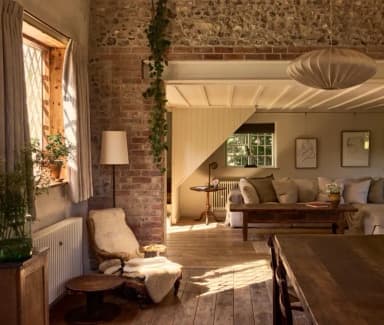
Old and new together: an antique painted door on a Versailles floor

Panelled doors and parquet, the ornament kept
No signature style
"Futuristic", "unconventional", "eclectic" and "idiosyncratic" are all words that have been used to describe his architecture. Venturi, the son of a Philadelphia fruit merchant, worked against a recognisable house style: he wanted each design to answer its own site and its own brief. What his buildings share is that they are spatially intricate, deliberately combining elements that do not quite agree.
He worked for most of his career with his wife and partner, the architect and planner Denise Scott Brown, in the practice that became Venturi, Scott Brown and Associates.
Vanna Venturi House: one of the first postmodern buildings?
He began the house for his mother, Vanna, in 1959, aged 34 and teaching at the University of Pennsylvania. It was completed in 1964 in Chestnut Hill, Philadelphia, and challenged the rules of modern architecture. Against Mies van der Rohe's "Less is more", Venturi answered "Less is a bore".
The house reinterprets the ordinary American suburban house. It has the horizontal ribbon windows and plain rendered front of modernism, but it adds ornament: an arch that carries nothing, a stair narrower than usual and a pitched roof with an oversized chimney. It is often described as one of the first postmodern buildings.
Writing in Architectural Record in 1982, as quoted by The Irish Times, Venturi said: "Some have said my mother's house looks like a child's drawing of a house ... I like to think this is so."

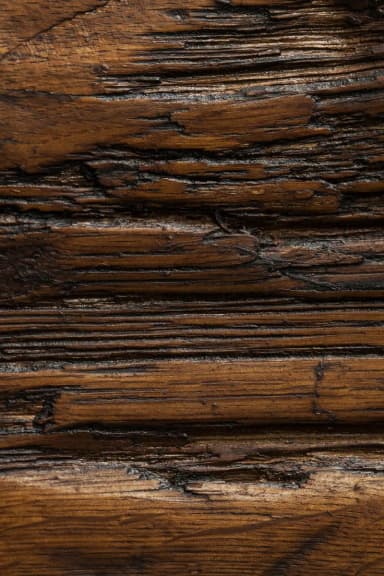
Pattern as ornament: a warm antique oak panel

Hand-made panels, each piece a little different
His famous works
- Guild House, Philadelphia (1964). One of his first buildings in his home city.
- Freedom Plaza, Washington (1980). Completed as Western Plaza on Pennsylvania Avenue, designed with the landscape architect George Patton, and renamed in 1988 in honour of Martin Luther King Jr.
- Seattle Art Museum (1991). The downtown museum opened in December 1991. Its street front is faced in limestone, with arches trimmed in coloured granite, marble and terracotta.
- Sainsbury Wing, National Gallery, London (1991). Venturi was named the preferred architect in January 1986, after an earlier scheme was refused. Building began in 1988, and Queen Elizabeth II opened the wing on 9 July 1991.
- Episcopal Academy Chapel, Pennsylvania (2008). He first designed a chapel for his old school in 1950 as his master's thesis at Princeton; it was never built. The chapel his firm built for the school's new campus at Newtown Square was completed in 2008.
The Pritzker Prize and Denise Scott Brown
Venturi received the Pritzker Architecture Prize in 1991, and in 2002 he and Denise Scott Brown shared the Vincent Scully Prize. The Pritzker went to him alone, although the work was shared, and in 2013 a petition asked the jury to recognise Scott Brown retroactively. The jury declined: "A later jury cannot re-open, or second guess the work of an earlier jury."
At Re:claimed we supply wood for architects and designers on projects of every kind, old and new; you can see some of them in our projects.
FAQ
What is Robert Venturi known for?
For rejecting the bare simplicity of modernism, summed up in his phrase "Less is a bore", and for buildings that mix history, ornament and everyday forms.
What are Robert Venturi's most famous buildings?
The Vanna Venturi House in Philadelphia, Guild House, Freedom Plaza in Washington, the Seattle Art Museum and the Sainsbury Wing of the National Gallery in London.
Was Robert Venturi a postmodern architect?
His mother's house is often called one of the first postmodern buildings, and his writing helped open the way for the movement, although he refused to be tied to any one style.
Who did Robert Venturi work with?
Above all Denise Scott Brown, his wife and partner, with whom he wrote Learning from Las Vegas and ran the practice Venturi, Scott Brown and Associates.
When did Robert Venturi die?
On 18 September 2018, at his home in Philadelphia, aged 93.
Re:sources
- The Pritzker Architecture Prize, Robert Venturi, 1991 laureate.
- The National Gallery, The Sainsbury Wing at 20.
- National Park Service, Freedom Plaza.
- Venturi Scott Brown, project index by date and biographies.
- University of Washington, Pacific Coast Architecture Database, Seattle Art Museum.
- Architectural Record, No retroactive prize for Denise Scott Brown.
- Our journal on George Nakashima and Versailles flooring.


