


Texture and pattern are two of the biggest elements in the interior design process, and on many levels some of the trickiest to work with. Used well, they heighten our experience of a space, because they awaken different senses, the ones we rely on to feel connected to the world around us.
The short answer
- Texture is how a surface feels, or how it looks as though it would feel: rough, smooth, ridged, soft.
- Pattern is a design that repeats: a stripe, a check, a herringbone.
- The two often overlap. Repeat a texture in an ordered way and it becomes a pattern, as it does in a brick wall or a parquet floor.
- Floors matter most, because they are among the largest surfaces in any room.

Hand Made French Oak herringbone: the texture of the wood, the pattern of the laying

The same idea on paper, a working drawing from our workshop
What is the difference between pattern and texture?
Texture belongs to the surface. Pattern belongs to the arrangement. You could close your eyes and find the texture of an oak board with your fingertips, the saw marks and the raised grain, whereas you need to step back to see the pattern it has been laid in.
Texture also reaches us through the eye. Different textures produce different shadows depending on the light they are exposed to, the time of the day and even the proximity of reflective surfaces, so a rough wall changes from morning to evening. Even so, we mostly associate texture with the sense of touch, one of the senses we rely on from a very young age. To confirm this we just need to see how children feel a need to touch everything in their reach to actually experience it.
Patterns work differently. They stimulate the brain and make us see things in another way. The repetitive use of large patterns on a small wall may make it appear smaller than it already is, while non-geometric designs provide excellent camouflage for surfaces with irregularities.

Pattern first: a geometric panel in oak

Texture first: the quiet grain of a chevron in Cabin Wood
How does texture create pattern?
Texture becomes pattern the moment it repeats in an order. The bricks in a wall are rough things in themselves, and the bond they are laid in makes the pattern. The same is true of a woven basket, a ribbed plaster or a dry-stone wall.
Parquet is the clearest example we know, because a herringbone floor can be laid in a single timber and a single finish, with no change of colour at all. The pattern comes from the grain changing direction block by block, so that each one takes the light a little differently. Walk across the room and the pattern shifts with you. A Versailles panel goes further, and in our workshop it begins as a drawing on squared paper before any oak is cut.

Why do floors matter so much?
Given the importance of both texture and pattern, it is no surprise that floors, undoubtedly among the largest surfaces in any property, be it commercial or residential, have such a major impact on how we make use of a specific space. The significance of flooring has been understood for centuries. Even during the Roman Empire, floors were highly designed and decorated with mosaics, and in France the parquet of the 17th century turned the same instinct into timber.
Floor patterns are so important in everyday life that they have been studied for what they do to us. In research led by Bram Van den Bergh at Rotterdam School of Management, closely spaced horizontal lines on a shop floor slowed shoppers down, because the end of the aisle seemed further away, and widening the gaps sped them up. The researchers observed 4,000 people, and those who slowed down remembered more of what they had seen.
Patterns and textures are also studied for health reasons, such as to find the best way to ensure people with dementia feel safe and comfortable navigating a space. Northern Ireland's public advice service suggests avoiding bold patterns and stripes, which can be confusing and disorientating, and shiny floors, which may be taken for wet ones.

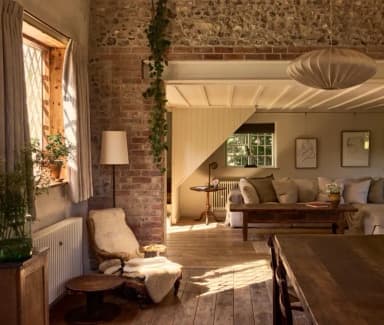
Brick and old oak, two rough surfaces at ease with each other

A plain armchair lets the Versailles panels speak
How do you use pattern and texture together?
There are no fixed rules, but a few habits help.
- Start with the largest surface. The floor is laid first and stays longest, so let it set the tone for everything else.
- Let one thing lead. If the floor carries a strong pattern, a herringbone or a chevron, let the walls be calm. A plain plank floor can carry more on the walls.
- Vary the scale. One large pattern and one small sit together better than two of the same size.
- Mix rough with smooth. Worn oak beside linen or plaster is restful, and a room of nothing but polished surfaces can feel cold.
- Look at it in real light. Lay a sample on the floor and come back to it in the morning and in the evening, because texture changes with the sun.
For more on how the layout of a floor changes a room, see our articles on wood floor patterns and on whether a herringbone floor is a good idea.

A Versailles panel at 707 x 707 mm, drawn by hand

The finished pattern in a London hallway
Pattern and Texture FAQs
What is the difference between pattern and texture?
Texture is the quality of a surface, how it feels or looks as though it would feel. Pattern is a design that repeats across a surface. A single oak board has texture, and a herringbone floor has both.
What is pattern in interior design?
Any repeated motif or arrangement in a room, from stripes and checks on fabric to the layout of a floor. Pattern adds rhythm and can change how large a space seems.
What is texture in interior design?
The tactile quality of the surfaces in a room, such as rough brick, soft wool or worn oak. It adds depth and warmth, even in a room of one colour.
What is an example of using texture to create pattern?
A herringbone floor laid in one timber and one finish. The only thing that changes is the direction of the grain, and that alone draws the pattern.
Can you mix patterns and textures in one room?
Yes. Vary the scale, let one surface lead and leave the eye somewhere to rest.
Re:sources
- Van den Bergh B., Heuvinck N., Schellekens G.A.C. and Vermeir I. (2016), Altering Speed of Locomotion, Journal of Consumer Research 43(3), 407-428.
- Rotterdam School of Management (2017), Research finds how supermarkets can control our speed of walking.
- nidirect, How to make your home dementia friendly.

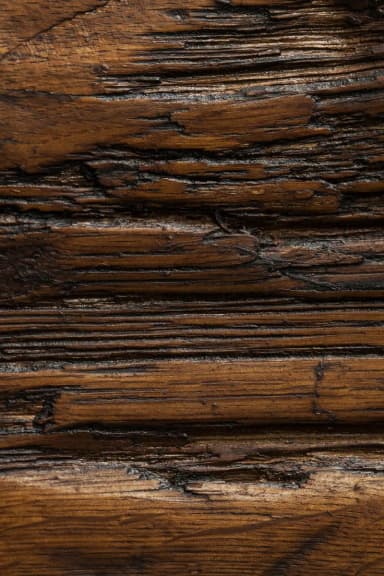
Sawn boards: all texture

Pale boards: all grain


